
Bottom of Faux Bois Bench before Staining

Bottom of Faux Bois Bench before Staining

Women are Meant to be Loved, Not to be Understood

Cloud
Oil on Canvas, 9×12
Commissioned
Here’s a Millay poem to go with this painting of a little woodland dog:
The Wood Road
If I were to walk this way
Hand in hand with Grief,
I should mark that maple-spray
Coming into leaf.
I should note how the old burrs
Rot upon the ground.
Yes, though Grief should know me hers
While the world goes round,
It could not in truth be said
This was lost on me:
A rock-maple showing read,
Burrs beneath a tree.
— Edna St Vincent Millay
Here are a couple of photographs of Cloud too. Such a cutie!

Photograph by Nona Hyytinen

Photograph by Neal Peterson

Me, Neal, Andrea and Joyce at Chicagoan Falls
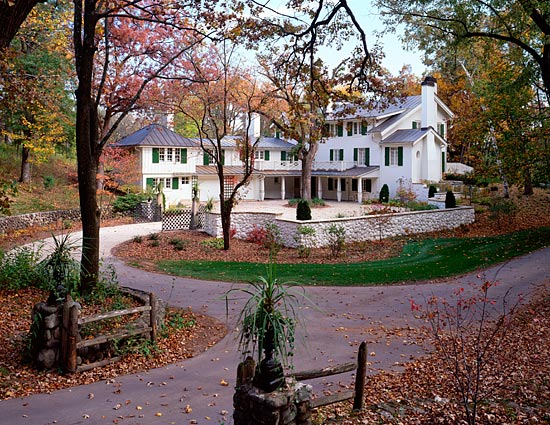
Last Friday, I went (for my second time) with friends, Andrea, Sue and Sandy to visit the Historic House, Ten Chimneys, in Genesee Depot, WI. It is quite simply the most enchanting place I’ve been. It was designed to be enchanting, by it’s actor-owners, Alfred Lunt and Lynn Fontanne, who dominated American theater in the first half of the Twentieth Century.

Alfred bought the original property to house his mother and siblings and provide a retreat for himself and Lynn during the off-season, a place to rusticate. No one ever went a’ rusticating in such style! Through the years, their decorating genius and inspired hospitality transformed the property of a house and several utilitarian buildings to include two residences, a stable, a studio, an extremely posh chicken coop and a bathhouse next to the pool. A friend of the Lunts, set-designer, Claggett Wilson, spent two years painting the walls and ceilings of the residence. The foyer, dining room, and for lack of a better description, living room are decorated with figures of hospitality, Biblical narratives and other devices. One newspaper article called Ten Chimneys the Lunts’ “Swedish Manor House,” and though I had to reflect a moment, that is probably quite accurate. Alfred was Swedish and as a child had lived on in a Swedish colony in Helskinki (caled Helsingfors in Swedish), Finland. His Finnish design roots tickle me! According to Design for Living, Alfred Lunt and Lynn Fontanne, A Biography by Margot Peters, “Finland thus became a large presence in Alfred’s life: its lakes and forests, timbered buildings, vivid textiles, and short bright summers….He enjoyed his Swedish cousins, took countless photographs, sketched Scandinavian decor, sang Finnish folk music. His father had been Swedish; in Scandinavia he felt at home.” The designs in the main house are sophisticated and cosmopolitan, but in essence, Scandinavian. The cottage is wholly Scandinavian.
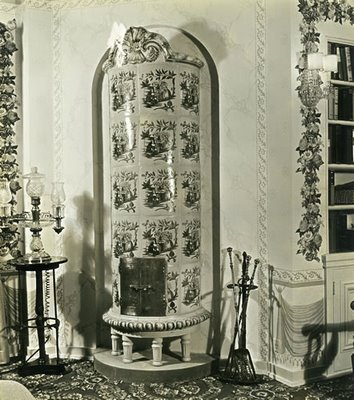
A Swedish Tile Stove

The Cottage
There are a number of great black and white photos of Ten Chimneys and the murals created by Claggett Wilson may be viewed at this Website.


Pool Party!
Some of the inspiring things I learned were that Alfred employed teenagers from the community to cook, under his supervision, for the dinner parties they were fond of holding. Lucky kids to learn from a Cordon Bleu graduate! Some of the wall painting in the cottage was done by Alfred himself, including a room decorated to surprise and honor a friend and associate, who would henceforth be sleeping there.

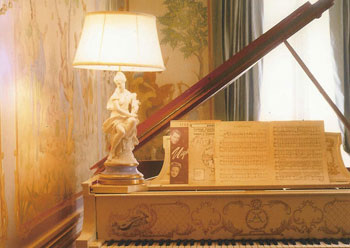
I also love the fact that they staged their candid shots, as below. Lynn would never be caught in curlers! A little artifice for the sake of creating an idyll in others’ minds acts works, to my mind, as a sort of benediction.
The Lunts’ designing, theatrical minds created a magical haven for their friends. They may not have lived the country life we know in reality, but they provided the country life we dream of. We need to believe in charm. We need to believe that beauty is possible in everyday life. Ten Chimneys inspires us to do whatever we can to make life lovely! Go there!


D’Artagnan Detail
3 hour oil sketch
9×12 Canvas
This sketch was begun at our Monday Night Drawing/Painting meetings. Knowing I had only the two hours and we wouldn’t have a chance to do additional work on this pose, I decided to develop the head and shoulders sufficiently before moving on. I added the sword, breeches and banner at home.

D’Artagnan
…I am a part of all that I have met:
Yet all experience is an arch wherethrough
Gleams that untraveled world, whose margin fades
Forever and forever when I move.
How dull it is to pause, to make an end,
To rust unburnished, not to shine in use!
As though to breathe were life. Life piled on life
Were all too little, and of one to me
Little remains; but every hour is saved
From that eternal silence, something more,
A bringer of new things; and vile it were
For some three suns to store and hoard myself,
And this grey spirit yearning in desire
To follow knowledge like a sinking star,
Beyond the utmost bound of human thought.
…There lies the port; the vessel puffs her sail:
There gloom the dark broad seas. My mariners,
Souls that have toiled, and wrought, and thought with me —
That ever with a frolic welcome took
The thunder and the sunshine, and opposed
Free hearts, free foreheads — you and I are old:
Old age hath yet his honour and his toil;
Death closes all: but something ere the end,
Some work of noble note, may yet be done,
Not unbecoming men that strove with Gods.
…’Tis not too late to seek a newer world.
Push off, and sitting well in order smite
The sounding furrows; for my purpose holds
To sail beyond the sunset, and the baths
Of all the western stars, until I die.
It may be that the gulfs will wash us down:
It may be we shall tough the Happy Isles,
And see the great Achilles, whom we knew.
Though much is taken, much abides; and though
We are not now that strength which in old days
Moved earth and heaven; that which we are, we are;
One equal temper of heroic hearts,
Made weak by time and fate, but strong in will
To strive, to seek, to find, and not to yield.

Contemplation
This is a 9×12 painting that began as a 2-hour life study. I then worked on it a bit from imagination, adding background and softening the edges. The Chinese symbols mean contemplation.
Here’s a poem for those who contemplate in coffee shops:
Bridal Shower
Perhaps, in a distant cafe,
four or five people are talking
with the four or five people
who are chatting on their cell phones this morning
in my favorite cafe.
And perhaps someone there,
someone like me, is watching them as they frown,
or smile, or shrug
at their invisible friends or lovers,
jabbing the air for emphasis.
And, like me, he misses the old days,
when talking to yourself
meant you were crazy,
back when being crazy was a big deal,
not just an acronym
or something you could take a pill for.
I liked it
when people who were talking to themselves
might actually have been talking to God
or an angel.
You respected people like that.
You didn’t want to kill them,
as I want to kill the woman at the next table
with the little blue light on her ear
who has been telling the emptiness in front of her
about her daughter’s bridal shower
in astonishing detail
for the past thirty minutes.
O person like me,
phoneless in your distant cafe,
I wish we could meet to discuss this,
and perhaps you would help me
murder this woman on her cell phone,
after which we could have a cup of coffee,
maybe a bagel, and talk to each other,
face to face.
— George Bilgere
I must confess, I far prefer talking to people face to face, although I have never had an urge to kill someone on a cell phone. (I text.) But I do really like the thought that someone apparently talking to themselves just might be talking to God.

My Cousin’s Kalamokki
I’ve been out of town weekend after weekend lately and only painting on Monday nights, so since Cookie I haven’t any finished paintings to post. However, in accordance with my plan to learn the art of landscape paintings, I have been out looking for subjects. I’ve wanted to paint saunas for some time and remembered that my cousin has a “kalamokki” in Minnesota. I was up there this past weekend and photographed it. (For those of you who can read Finnish — incidentally, that o is supposed to have an umlaut above it — there’s a joke in it.)

Bath House by Alexei Trachev
Here is an example of a sauna painting by Russian impressionist painter, Alexei Trachev. He and his brother, Sergei, gained the opportunity to become artists under the Soviet system of collective farms and factories and schools, an opportunity they would unlikely have had under the Czarist system. The Soviet philosophy was a double-edged sword though. On the one hand, they were able to educate themselves as artists; on the other hand, Russian artists were discouraged from painting in the (Western European) Impressionist style, considered decadent. Subject wise, they were expected to laud the Revolution by depicting triumphant industrialization and the equality of the people.
I’ve seen quite a few of these Soviet era paintings, and I can’t say I’m entirely repelled by their propaganidistic intent. Some of them seem plastic and uninteresting, but in many, the personalities of the artists and the subjects still come through. They are portraits of a people living through an era of enormous transformation, learning new skills, but retaining their character, family ties and regional flavor.
The Trachev brothers painted all the time. They painted their own families, their village life and traditions. These Russian impressionists and many others painted for themselves, for the love of it. They weren’t pursuing commerce; they were expressing themselves. I must write more about them in another blog entry.
Anyway, back to sauna paintings. Here is one by Akseli Gallen-Kallela. When a Finn paints a sauna, he’s painting the most conspicuous Finnish institution there is.
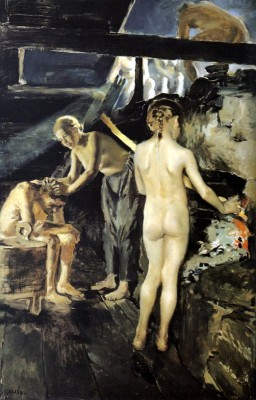
In the Sauna by Akseli Gallen-Kallela
So, anyway, you get the idea. Gallen-Kallela’s isn’t a landscape painting, of course. Saunas are a great subject!
I was also recently lead to a stone bridge I’ve been looking for for several years. I saw it first when I was delivering my late-husband to a boat-landing where he was going to go ice-fishing. There was this gorgeous stone bridge, laden with fresh snow, with the mist from a dark stream rising below it. I immediately wanted to paint it. I hadn’t brought any painting equipment up to Eagle River though, just my skis, so it had to wait for a different time. After he died, I couldn’t find it. I’d gone out looking on my own a couple of times and always got lost — not an uncommon occurrence for me — until I began to think Kentuck Lake Road represented my personal Bermuda Triangle. A year later, I got serious and started a systematic search of the roads I thought it lay on, bringing friends, Josephine, Neal and Andrea, along for “safety” and the shared experience. On the first foray, my truck stopped working while we picknicked on the side of a forest road. We would have been stranded and camping for the night, as there wasn’t any cell service, except that Josephine flagged down the single passing vehicle we saw for hours, a forest ranger, and he used his walkie talkie to radio his office and give our location to the owner of a tow truck! Our second foray also produced no results. We’d exhausted all our hunches. I was beginning to think the bridge only reappeared once every hundred years, as Brigadoon did in the musical. Finally, Neal got a hot tip from an antiques dealer on Butternut Lake, and we were directed right to it. Sigh….It really does exist! Of course, it wasn’t anywhere near where I thought it was, but I’ve grown used to being invariably wrong when a sense of direction is wanted.
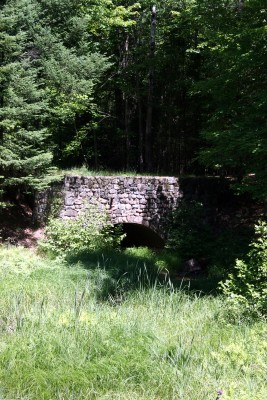
The Brigadoon Bridge
Last, I photographed the cabin my cousin Cheri’ husband, Jere, grew up in. I’ve painted it before during my first Plein Air Workshop in 2006, but hope to do a more inspiring job on my second attempt.

Jere’s Log Cabin
So there is plenty to work on!
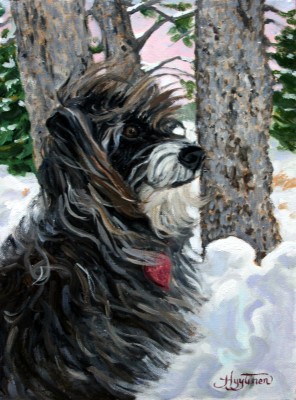
Cookie, Neal’s Cairn Terrier Mix
9×12 Oil on Canvas
This is a portrait commisssion of a very active little dog who rarely stops hunting, unless she’s sitting on my friend Neal’s lap. Then Cookie is a cuddly as you please. I cannot believe this little dog can catch the things she does or that she can make her way through snow drifts with such aplomb!
Here is a winter-inspired poem by Ralph Waldo Emerson to take our minds away from the drought-ridden, hot Midwest and to summon cooler weather.
The Snowstorm
Announced by all the trumpets of the sky,
Arrives the snow, and, driving o’er the fields,
Seems nowhere to alight: the whited air
Hides hills and woods, the river, and the heaven,
And veils the farm-house at the garden’s end.
The sled and a traveller stopped, the courier’s feet
Delayed, all friends shut out, the housemates sit
Around the radiant fireplace, enclosed
In a tumultuous privacy of storm.
Come see the north wind’s masonry.
Out of an unseen quarry evermore
Furnished with tile, the fierce artificer
Curves his white bastions with projected roof
Round every windward stake, or tree, or door.
Speeding, the myriad-handed, his wild work
So fanciful, so savage, nought cares he
For number or proportion. Mockingly,
On coop or kennel he hangs Parian wreaths;
A swan-like form invests the hidden thorn;
Fills up the farmer’s lane from wall to wall,
Maugre the farmer sighs; and at the gate
A tapering turret overtops the work.
And when his hours are numbered,
and the world
Is all his own, retiring, as he were not,
Leaves, when the sun appears, astonished Art
To mimic in slow structures, stone by stone,
Built in an age, the mad wind’s night-work,
The frolic architecture of the snow.
It would be so cozy to be reading by a fireplace, wrapped in a blanket with a hot toddy, listening with half an ear to the wind howling as the snowflakes swirl outside the window.