Packer Backer

Green Bay Pug

Packer Backer

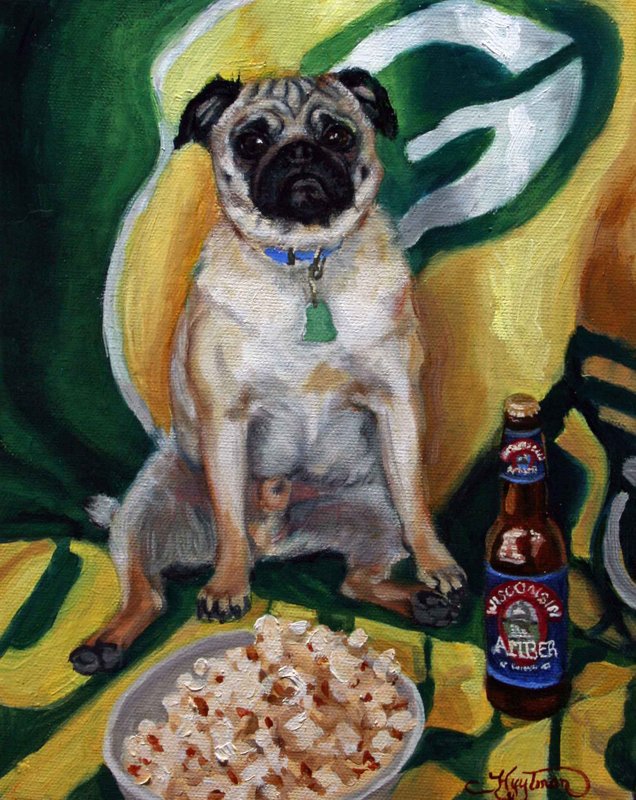
I actually painted this 8×10 picture of my darling Pippin a while back, at the beginning of the football season.  Now the season is winding up, but watching football is always the same, isn’t it?  At least in terms of our comfort foods, a beer, a Bloody Mary, nachos….

Here is a poem for football fans.  It goes along with nachos and beer.  It’s about iceberg lettuce, the football fan’s health food.

The Iceberg Theory

all the food critics hate iceberg lettuce.

you’d think romaine was descended from

orpheus’s laurel wreath,

you’d think raw spinach had all the nutritional benefits attributed to it by popeye,

not to mention aesthetic subleties worthy of

verlaine and debussy.

they’ll even salivate over chopped red cabbage

just to disparage poor old mr. iceberg lettuce.

I guess the problem is

it’s just too common for them.

it doesn’t matter that it tastes good,

has a satisfying crunch texture,

holds its freshness,

and has crevices for the dressing,

whereas the darker, leafier varieties

are often bitter, gritty and flat.

it just isn’t different enough and

it’s too g_damn american.

of course a critic has to criticize:

a critic has to have something to say.

perhaps that’s why literary critics

purport to find interesting

so much contemporary poetry

that just bores the s__t out of me.

at any rate, I really enjoy a salad

with plenty of chunky iceberg lettuce,

the more the merrier,

drenched in an italian or roquefort dressing.

and the poems I enjoy are those I don’t have

to pretend that I’m enjoying.

by Gerald Locklin


Bling

Sampson and Brandi Redo

Bling

The subject of this painting, an Italian Grehound named Samson, is owned by a friend, Brandi.  I love these dogs’ doe-like eyes and refinement.  Samson is so fragile-looking and gentle.  He just begs to be cuddled with.

I finished this 6×6 painting of an Italian Greyhound last Sunday.  It was a perfect snowy day outside and I was working in the studio, semi-watching (i.e. taking occasional glances towards) Star Wars and The Sound of Music.  I don’t have a DVD player in my studio, and ordinarily I listen to audio books;  I just have a VCR.  However, VCRs were in existence a lot longer than DVD or HD Streaming have been around, so although I have an ever-growing DVD collection my VHS movie collection is much larger, and of course, I bought all my old, favorite movies as soon as VCRs were invented, so the studio theater remains important.

Here is a poem on the subject of our corporeality.   I like the way Judith Sutphen describes the resignation with which we all see our own bodies.

Living in the Body

Body is something you need in order to stay

on this planet and you only get one.

And no matter which one you get, it will not

be satisfactory.  It will not be beautiul

enough, it will not be fast enough, it will

not keep on for days at a time, but will

pull you down into a sleepy swamp and

demand apples and coffee and chocolate cake.

Body is a thing you have to carry

from one day into the next.  Always the

same eyebrows over the same eyes in the same

skin when you in the mirror, and the

same creaky knee when you get up from the

floor and the same wrist under the watchband.

The changes you can make are small and

costly — better to leave it as it is.

Body is a thing that you have to leave

eventually.  You know that because you have

seen others do it, others who were once like you,

living inside their pile of bones and

flesh, smiling at you, loving you,

leaning in the doorway, talking to you

for hours and then one day they

are gone.  No forwarding address.

by Joyce Sutphen


Crete and Santorini — The Rise and Fall of Minoan Civilization — Andante Travels: Part II

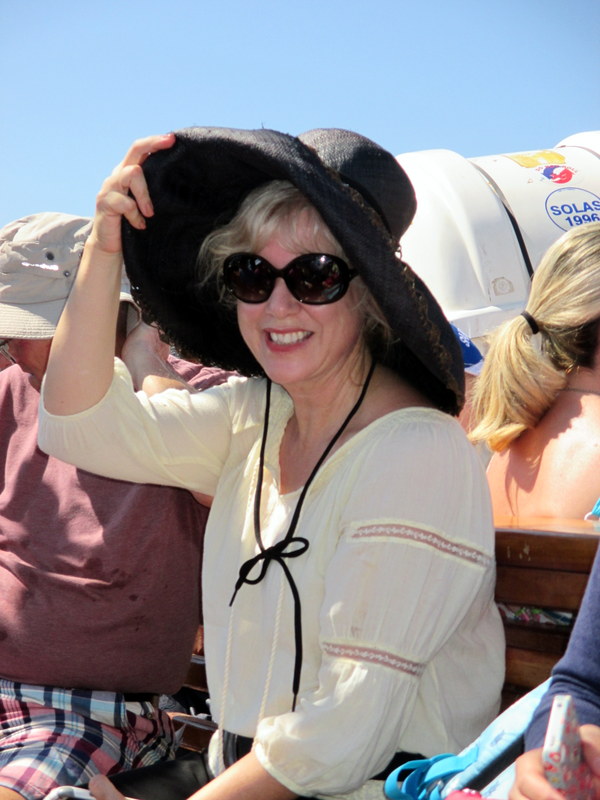
Andrea on the Excursion Boat in Santorini

Andrea on the Excursion Boat in Santorini

To continue….

Scrottling at Phaistos, I found a sherd with a red stripe and blackened scorch marks, which Sandy identified as dating to 1800 BCE.  Of course, he didn’t give me the year to begin with.  He identified it as being from Middle Minoan IA, or something.  I felt like I’d found the Holy Grail.  Oh joy, oh rapture!

Another feature of Phaistos that we discussed is the way the Eastern side of the Central Courtyard (or Bull Ring) is left undeveloped, bedrock, unlike Knossos, where Sir Arthur Evans located the residential chambers, the Hall of the Double Axes and the Queen’s Rooms.  Both were illuminated directly by the rising sun.  At Phaistos, he said, there may have been a “rock garden,” sort of a “wild” area – it wasn’t very big – to sit and greet the morning in.  It was a very nice thought.  The area is at the edge of a crag.  We sat beneath the shade of the tree and gazed out upon the glory of the Megara Plain.  At Knossos Sir Arthur Evans had mistakenly built a wall, which effectively shuts out the sun in these chambers.  Thinking they were the King’s and Queen’s Quarters, he deemed privacy a necessity, but there never was a wall there in antiquity.  None of these “palaces” were walled.  They were open and contained entrances on all four sides.

We returned from our excursions for a lecture and dinner at the Hotel.  The lecture was fascinating.  Sandy had intimated during the preceding days that he would talk further about the Double Headed Axes (Doo Das) and the Horns of Consecration (Whatsit.

The import of the lecture was that Minoan culture was most influenced by Egypt.  Hatshepsut, the mother of Thutmose III, who acted as his regent and proclaimed herself Pharoah, received Minoans (Keftiu) asking for “the breath of life,” i.e. food.  There was famine in Crete    I can’t find my notes at the moment, so I’m winging it.  These suppliants are pictured in the tomb of one of her chief officials, Senemet.  They are completely identifiable by their costumes, wasp-wasted kilt, bare chests, lovelocks.  Would that men still dressed that way!

 Some are even carrying bull rhytons like the famous one in the Heraklion Museum.  By the time Thutmose III took over the throne, the Keftiu are gone.  They are replaced by the Prince of the Danae (Danaans, one of the Homeric terms for Greeks).

This helps fix the time of the Theran eruption, when the Minoan needed the assistance of Egypt to rebuild their home and the advent of the Mycenaean suzerainty over Crete.  Greek myth states that Daedalus was taught architecture in the Egyptian Faiyum, the first labyrinth.  Possibly the Minoans brought Osiris back, the god that is torn apart and reborn every year, and hieroglyphic phonetics.  Both Osiris and Isis make use of Double Ax iconography.  The famous Parisienne is wearing an Isis Knot.


At Gortyn we were waited on by a young man sporting an Isis Knot.  I had to ask Sandy for his interpretation.

Sandy also told us a part of the myth of Daedalus and Minos I’d never heard before.  As far as I knew, after Icarus fell into the sea, there were no further consequences to the escape.  However, (I’m quoting Wikipedia here) the myth of Daedalus also relates that after Icarus had fallen into the sea, Daedalus arrived safely in Sicily, in the care of King Cocalus of Kamikos on the island’s south coast, where Daedalus built a temple to Apollo, and hung up his wings, an offering to the god.  Minos, meanwhile, searched for Daedalus by travelling from city to city asking a riddle. He presented a spiral seashell and asked for a string to be run through it. When he reached Kamikos, King Cocalus, knowing Daedalus would be able to solve the riddle, privately fetched the old man to him. He tied the string to an ant which, lured by a drop of honey at one end, walked through the seashell stringing it all the way through. Minos then knew Daedalus was in the court of King Cocalus and demanded he be handed over. Cocalus managed to convince Minos to take a bath first, where Cocalus’ daughters killed Minos. In some versions, Daedalus himself poured boiling water on Minos and killed him.

The anecdotes are literary, and late; however, in the founding tales of the Greek colony of Gela, founded in the 680s on the southwest coast of Sicily, a tradition was preserved that the Greeks had seized cult images wrought by Daedalus from their local predecessors, the Sicani.[   (Wikipedia)

Sandy mentioned that the Minoan fleet that had gone in search of Daedalus were lost at sea in a great storm or by a great wave, possibly by a tsunami from the eruption of Thera.  In any case, the tsunami did destroy Crete’s fleet and put an end to their thalassocracy, opening the way for the Mycenaeans to invade.

But, about the Horns of Whatsit, Hathor is often represented as a bovine head.  There is a rising sun between her horns.  The Egyptian symbol for the horizon also looks like the Horns of Consecration.

I’ve had an interest in Egypt as a backdrop for Bronze Age Greece, the foil of the Hittites, who were the allies of the Trojans, but I’ve never really been smitten by Egyptology, in spite of Amelia Peabody et al.  My interest has been awakened though, especially since I’ve been reading Nefertiti and The Heretic Queen by Michelle Moran.

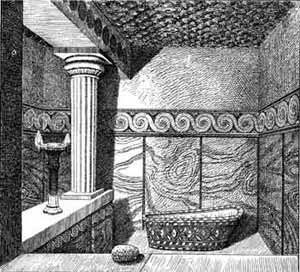
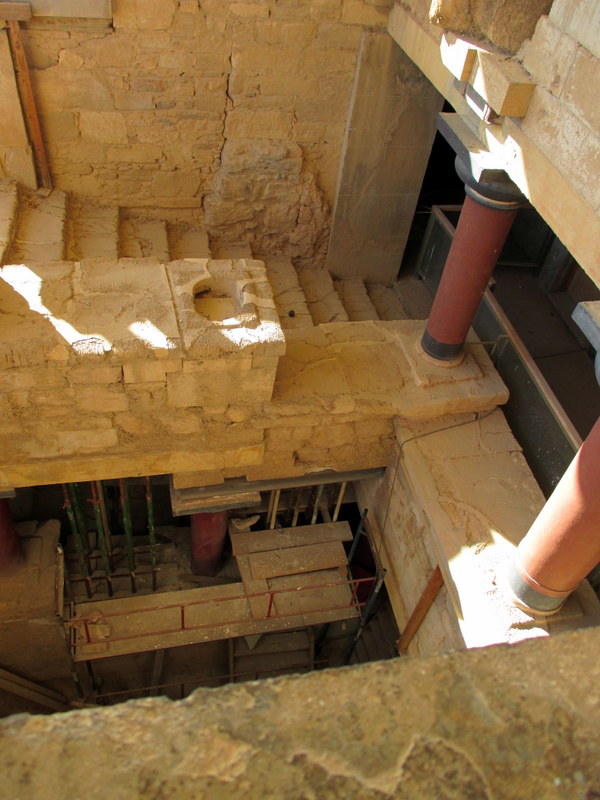
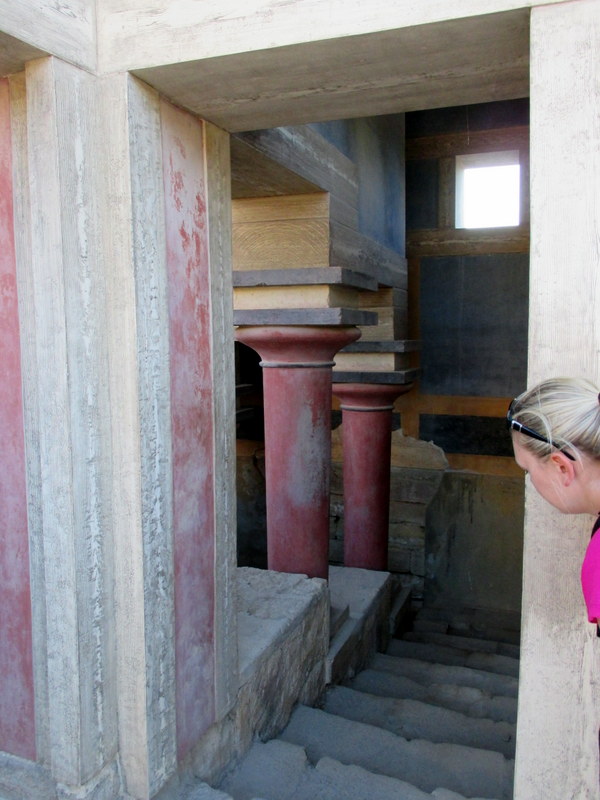
Another feature of Minoan construction were “Lustral Basins.”   Sir Arthur Evans was the first to call them that.  These are small, sunken chambers reached by a stairway.  In the case of Knossos, there is a Lustral Basin off  the throne room connected by an L-shaped or dog-legged stairway, Lustral Basins.  There is often a balustrade running alongside the stairway, normally ending with a pilaster supporting a column.   Lustral Basins were an inside joke, at least among Andrea, Geneia and I.  All of the examples at Knossos, like the one at Mallia were lined with gypsum and so Evans thought they were used for bathing—a clay tub was even found in one of them (see below). However, a few of them were found in areas of the palace, the Throne Room for example, where relaxing in the tub seems unlikely. We asked Sandy what it really meant, “lustral basin.”  He could only comment, with a shrug of the shoulders, that Evans thought it was there that the King or Queen went to “lustrate,” which left us none the wiser.


This interpretation has come under question in recent years, however. For one thing, the rooms are not very well designed for that particular purpose. Gypsum is not the ideal waterproofing agent (for one thing, it is somewhat water soluble) and, in any case, not all of them have paved floors. The fact that—in a palace noted for its superb plumbing— there are no drains in any of the rooms also raises doubts. Of course, it can be argued that the bathing was done in clay tubs, which were then carried away by servants to be emptied but that assumes that the tub found in the bathroom of the so-called Queen’s Quarters at Knossos (above) was used for that purpose. In fact, they are a type of coffin known as a larnax .Many lustral basins were found to contain cult objects such as offering tables or sacred vessels and the walls are often decorated with religious themes, such as the those (see above) associated with the gathering of the crocus harvest from House Xesté 3 at Akrotiri on Thera. This would seem to indicate a religious function, to be sure, but one more associated with the renewal of the nature. Many scholars now prefer the term Adyton, a Greek term meaning “off limits” and referring to the most holy part of a Classical temple.

The Linear A language has been worked on ever since the discovery of the ancient tablets and is as yet “officially” untranslated.  However, Sandy believes it has been deciphered by an amateur named Hubert LeMarle and that it is in fact Proto-Sanskrit.   LeMarle actually gave him his book – I have to find this – and Sandy shelved it along with all the other umpteen books claiming to have translated Linear A.  Later, when being consulted for a movie, he was asked for some Minoan chants, because the screenwriter or director needed his Minoans to be chanting something.  “What did they sound like?”  So, in order to give the guy something, Sandy grabbed LeMarle’s book down from the shelf and read him some transliterated mumbo-jumbo to be used in the background of Ariadne’s Dance..  Then, the movie-maker asked, “But what does it mean?”  So, Sandy went back to see what LeMarle had offered as a translation and found that it made complete sense.  For instance, one line read, “I have purified myself with olive oil..(inscription missing) holy water for my lady.”  He read on.  Another line read, “I consecrate thirty two units of wine to the heights of the heavens and for Ashera Deke, as I gazed at the moon.”

In the Linear A phonetics, the name Ashera is A-sa-sa-ra.  Now there is a Luwian (perhaps the language spoken by Trojans) Ashassarames; a Hittite Ishassarames, a Hurrian Ishera and a Canaanite Mother Goddess, Ashera.  Somewhere in this discussion (lecture), Sandy also wrote out As-i-rai-ro-ja.  I’m not sure if that was from the same inscription or another one, but he related it to Aser or Usar and thought it could be the same god as Osiris.

Anyway, for his part, Sandy now believes that Linear A is Proto-Sanskrit, hence Indo-European, and it offers all sorts of interesting lines of investigation.  He says that none of his colleagues have ever had any contact with Hollywood and he attributes his being a lone believer in LeMarle’s theory to this fact.  Haha

I almost stood up for my applause after this lecture and slide show.  There is a lot that I can’t remember sufficiently well to relate, but I LOVED it.  You just don’t get this on most vacations!

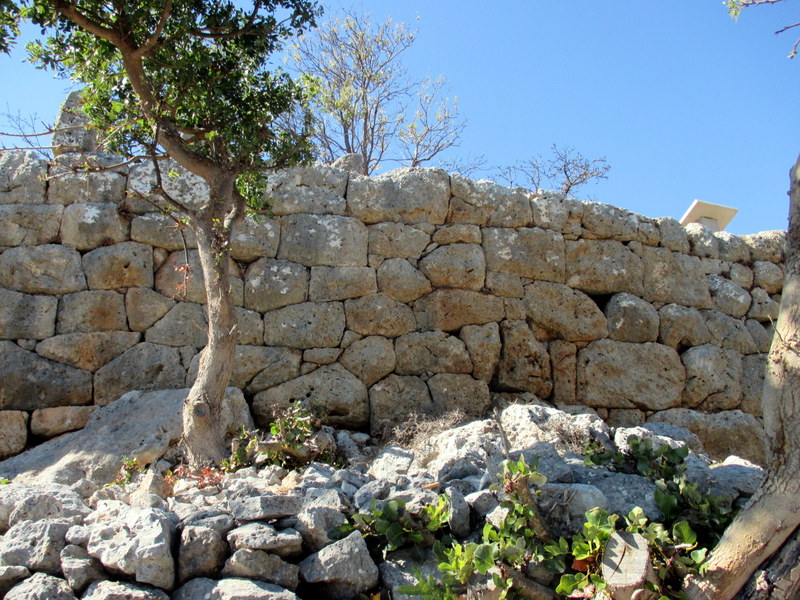
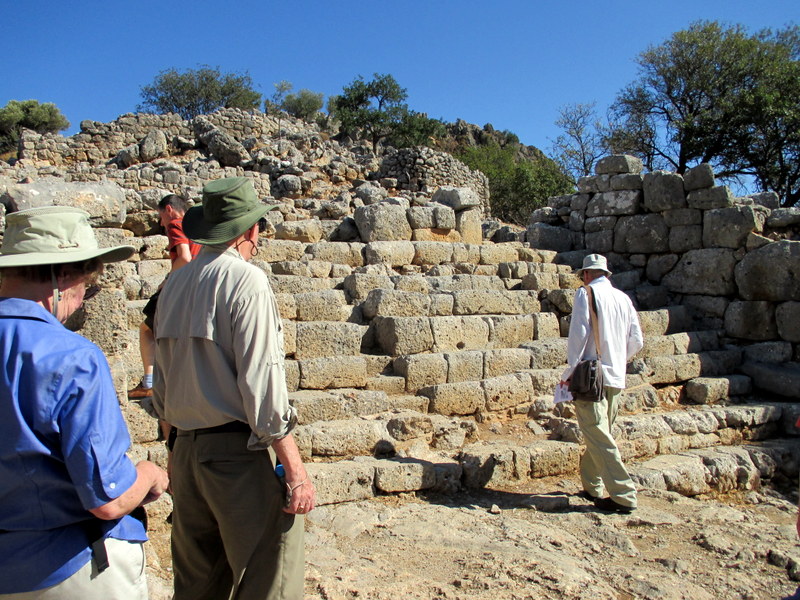
The next day, we visited the Archaic hilltop city of Lato, which initially looked older than it really is.  The builders of Lato intentionally imitated Cyclopean Wall structure, cutting irregular stones and piecing them together.  They evidently thought there would be some prestige in it.

Entrance to Lato:

Entrance to Lato:

Lato:  Harris, Kitty, Elaine, Ann Lato:  Cyclopean Walls Andrea at Lato Theatral Area, Lato

Latos

Latos

Notice in the pictures above, the imitation Cyclopean Walls, the Cistern with Steps Leading Down to Water Level, and the Theatral Area

Lato sprawled over several hills.  Geneia could have skipped the rest of the day just to climb these hills and explore the maze of great stone walls.  We were shown the meeting place for administrators, with a central fireplace and sofas.  They took their meals there and came to the door after discussion to announce decisions.  Outside there was steps upon which were held public meetings.  Steps were often built for seating.  Nearchus, a former pirate who became Alexander’s best admiral, was from Lato.

In my notes, I have recorded that during Ottoman Rule, no excavating could be done on Crete.  In 1894, Evans considered digging at Lato, mistaking the architecture, especially the city gate, as a cyclopean citadel of the Mycenaean Age, but due to the Ottomans, he could not.  So, he went to Knossos, which he bought.

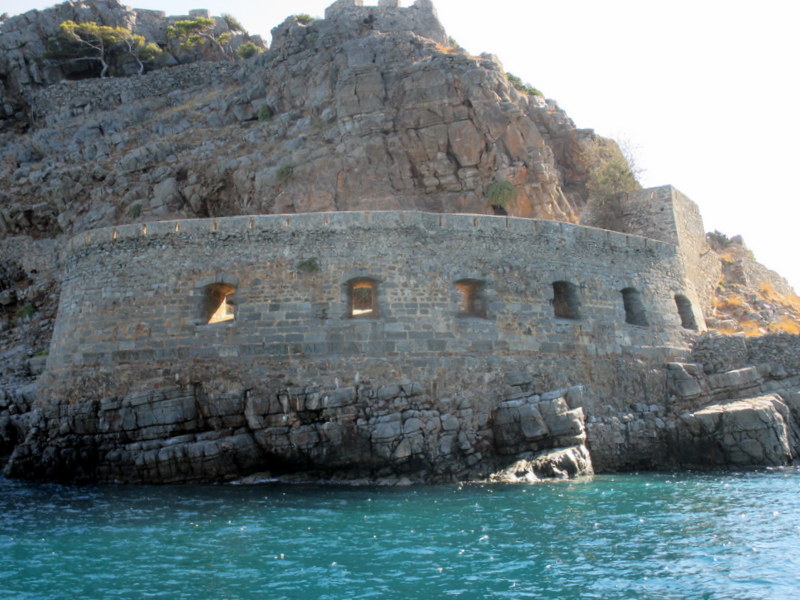
We had lunch near the sea, then took a cruise to the island of Spinalonga, a former leper colony.  It was mobbed with people, probably because it has become famous in a novel called The Island by Victoria Hislop, which several of our party had read.  There were so many subjects for plein air painting.  It’s really a lovely place, in spite of its being in ruins (see above).  That lends it a certain charm though.  It would be wonderful to spend the day wandering alone, if all the other tourists had departed.

Spinalonga

Spinalonga

Spinalonga Venetian Fortifications at Spinalonga Venetian gun ports by the Sea Symbol of Venice:  The Lion of St Mark, winged, and an open book Spinalonga SpinalongaNotice in one of the pictures above, the Symbol of Venice, the Lion of St Mark with an Opened Book, on the Old Venetian Fortress

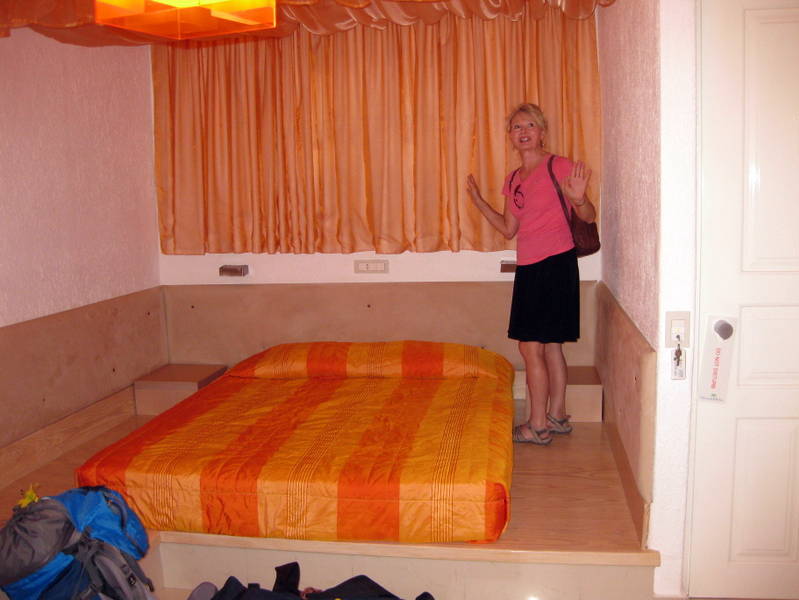
From Spinalonga, we drove to a new hotel, the Elounda Palm.  Our room was extremely…orange.

It's just a little orange in here!

It’s just a little orange in here!

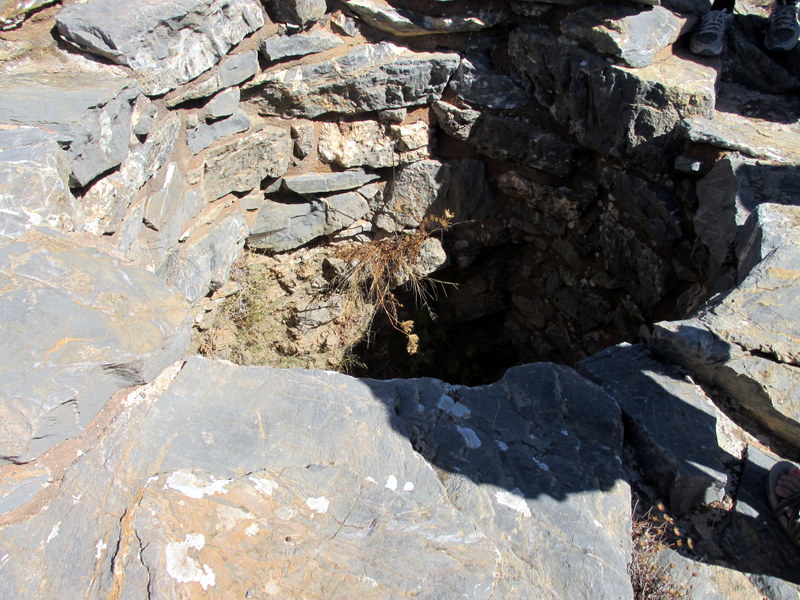
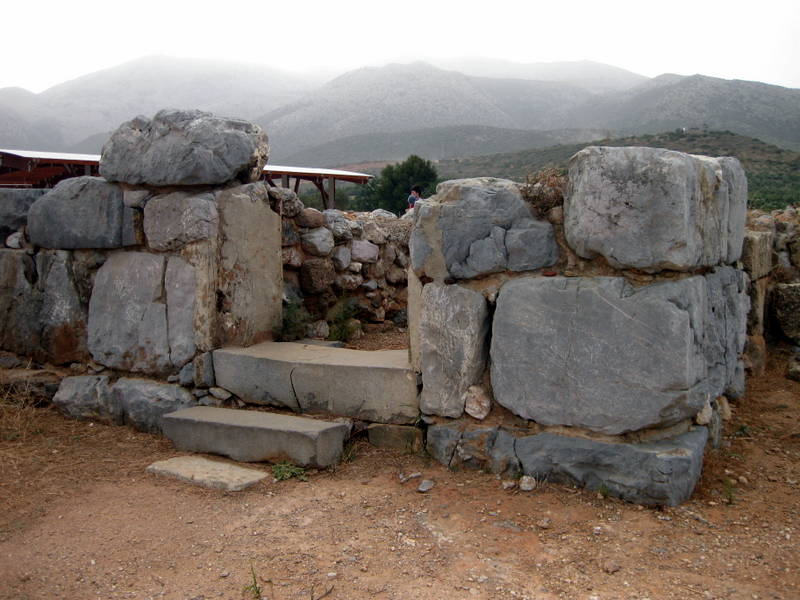
We were supposed to visit the well-preserved Minoan city of Gournia, but it happened to be closed on our scheduled day.  So instead we went to Vasilliki, which had been closed for quite a while for the sake of conservation.  Sandy was eager to see what had been done there, but could actually see no difference.  Scottling here,  I found the only piece of Vasilliki Ware found by anyone (see below).

The surface of the wares is covered with a red or brown semi-lustrous paint that appears mottled, an effect achieved by uneven firing.Vasilliki Ware was made in Early Minoan IIA and IIB (about 2500 to 2200 BCE) and has mottled glaze effects due to early experiments with controlling color.  Geneia found a tiny sherd of the even more exquisite Kamares Ware (see above).

We also found obsidian.

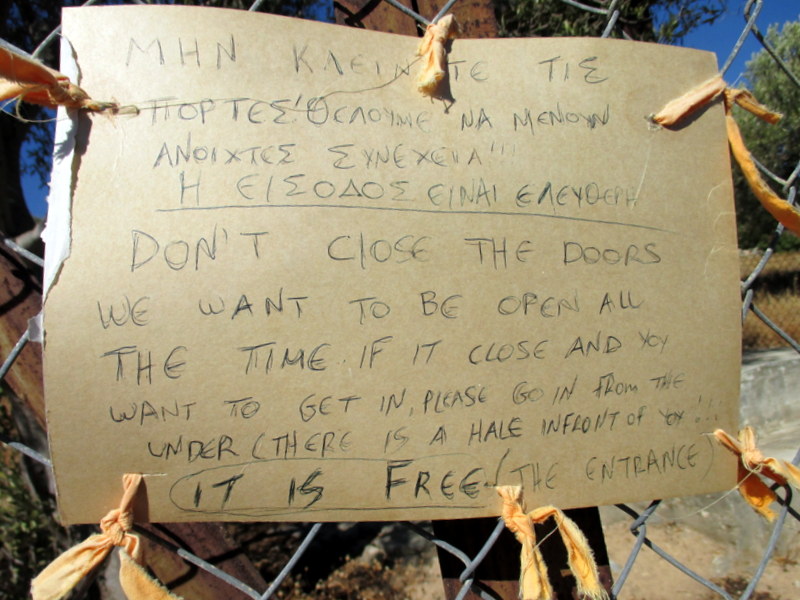
There was no guard at Vasilliki, as there had been at other archaeological sites.  The gate was cracked open and the linked wire fence had bent up next to the gate.  There was an “official” notice left by someone tied to the wire.

Homemade sign at Vasilliki

Homemade sign at Vasilliki

From Vasilliki, we drove to Chamaizi, the only round house in Crete.

Our Glamorous Companion on the Way to Chamaizi

Our Glamorous Companion on the Way to Chamaizi

It is – guess? – located on a high hill overlooking the sea.  It is an oval shaped building with a cistern in the center.

Cistern at the Center of the Round House at Chamaizi

Cistern at the Center of the Round House at Chamaizi

There is some mystery about how they obtained water up there.  One of our group, Ann Salusbury, brilliantly suggested to Sandy that the roof was sloped inward, allowing the rain to drip off the roof into the cistern.  Sandy wrote it down.  It’s location is evidence of the danger incurred by living at the sea’s edge.  After the end of the thalossocracy, Cretans were very mindful of the danger of piracy.  They built on high hills – I’d consider some of them mountains – and commuted daily to the sea to fish.  Chamaizi, and perhaps wine at lunch inspired me to write a song, or to be just, new lyrics to an old song  (All I want is a room in Bloomsbury from The Boyfriend).  It goes:

All I want is a house in Chamaizi,

Just a round house for you and me.

One roof’s enough for us;

Can’t be bothered with frill.

Can’t bring much stuff with us,

Cause we live on a hill!

Every evening we’ll gaze out to the sea,

Loving life in Minoan Mid (II) A or B.

Our new roof’s tipping;

The rain keeps dripping;

There’s plenty of water for tea,

In our darling round house in Chamaizi!

Pirates may swarm the coast,

But we won’t care.

We’ll moon them and wave our derrieres!

Nothing awes us

Except for Knossos!

We’re just delighted to be

In our dear oval house in Chamaizi!

Andrea, Geneia and I actually had the temerity to sing it to Sandy, Gudrun, Elia and Richard , Harris and Kitty and Diana  after dinner that night, complete with gestures and dance steps.  The next day Sandy called it “Chamaizi, the musical.”  I rather think this performance crowned the vacation for me.  (Authors have no modesty.)

We lunched that day at a café overlooking the island of Mochlos, which used to be attached to the mainland as a peninsula, but the level of the water rose in ancient times and cut it off as an island.  Mochlos was different from the other sites we’d toured.  The buildings were of shist masonry on the lower floor, with a mud brick upper floor.  Floors were also laid with slabs of shist.  All the others had been built predominantly of limestone.  The Late Minoan IA levels (1550 BCE?) are sealed by volcanic ash and pumice from the Thera volcano eruption .  The town was destroyed by fire at the end of Late Minoan , but not looted.  Human skeletons were found in the destruction levels, but bronze valuables ahd been hidden in two houses before they abandoned the town.  Immediately afterward the Greek language and Mycenaean burials began to occur.  Mochlos has an Early Minoan II (2500 – 2200 BCE) necropolis on a wide ledge overlooking the sea on the West side.  The tombs were built above ground and resembled Minoan domestic architecture, so they are commonly called “house-tombs”.  They are completely stone built, obviously by persons of some wealth.  Unsurprisingly they turned out to contain gold jewellery, silver plate vessels, stone vases and the earliest faience known in Crete.  An imported silver cylinder sea from Mesopotamia dating to reign of King Sargon of Akkad was also found in them.

Mochlos

Mochlos

Grandfather and Granddaughter casting off From MochlosElounda from Mochlos

We toured it before lunch and after lunch, Geneia and I swam across the “straits of Mochlos”and back.  Again, it was so gorgeous, but the brackish water was startling.  I find I just don’t care for brine, but the color is incomparable.  I was anxious to get back to our companions, relaxing in the taverna and clear my palate with water and wine.

We had one last night at the Elounda Palm Hotel and one more lecture.  I find that I’m unable to find my notes, but it was about the timing of the Theran eruption and gave the archaeological evidence, some of which I’ve related concerning the visitors to Hatshepsut and Thutmose III, versus the Carbon Date, resulting from a tree branch discovered beneath the ashes of Akrotiri.  Evidently it rendered a date of 1600 + or – 13 years.  He explained something about the “curve” of error and something else about the “curve” being flat during these particular years, which I’m afraid I didn’t understand.  He asserted that Radio Carbon dating was not entirely reliable, which I have read before.  The talk was designed to explain his comment early in the tour that the date of the Theran Eruption depended upon whether one was an archaeologist or a scientist.

The Elounda Palm Hotel was notable as a place where I could obtain a vodka.  I found that the British don’t drink vodka, and although we were served wine with every meal in Crete, lunch and dinner – a feature of Andante Tours that I ardently applaud – it was also rare in Crete, except where they were catering especially to foreigners.  I’d noticed Belvedere, an excellent and expensive Polish vodka in the bar when we arrived and thought to sample it later on.  It turned out that only the Pool Bar was manned in the evenings over dinner, so on night one I sauntered over to the Pool Bar to see what I could get.  They had Grey Goose, so I ordered a Grey Goose and splash of cranberry from the young, bearded, Cretan bartender.  He winked at me several times and spoke in a sultry voice, announcing to anyone who cared to hear that Grey Goose was a very fine, smooth vodka, as if commending my taste.  I thanked him with my typical bright sunny manner and retreated to dinner. It had been rather expensive, I thought.  Eight Euros!  I wondered if the general seductiveness had been white wash for charging me more than it was worth.  So, the next night I asked Richard Thornton, a charming Brit, married to an Italian and retired in Province, whether he thought I’d been overcharged.  I was satisfied after he told me what he’d paid for his drink that I had been charged the usual fee, which was indeed high, over $10.  He insisted on coming with me to the Pool Bar and even paid for my drink.  The sultriness was still there.  The guy said I could have “anything I desired.”  Did he double as a Pool Boy during the day?  We retreated back to our dinner.  I was glad I had Richard with me.

On our last day, the weather suddenly changed.  The sky became overcast and there was a wind that blew grains of sand all over our clothing and stuck to my lipstick.  We visited Mallia.

Mallia

Mallia

Theatral Area, Mallia Mallia

It was kind of poignant.  Here were all these people we’d spent the week with and I really liked them.   Elia and Richard invited us to come and visit them in Provence.  If it is at all possible, before they forget who we are, we’ll try.

We still had two more nights in England, but this was the end of the tour.  We said our goodbyes.  Joe and Elaine told me that Geneia and I had been “a ray of sunshine” throughout the trip, a tribute I that really gratified me.   It will be one of my warmest take-aways from this trip.  They were the people I’d like to emulate, adventurous and interested in everything.

I recommend Andante Travels to anyone interested in history and am enjoying reliving our days of travel as I sort through thousands of pictures (between Geneia, Andrea and I).  Viva Andante and the Minoans!

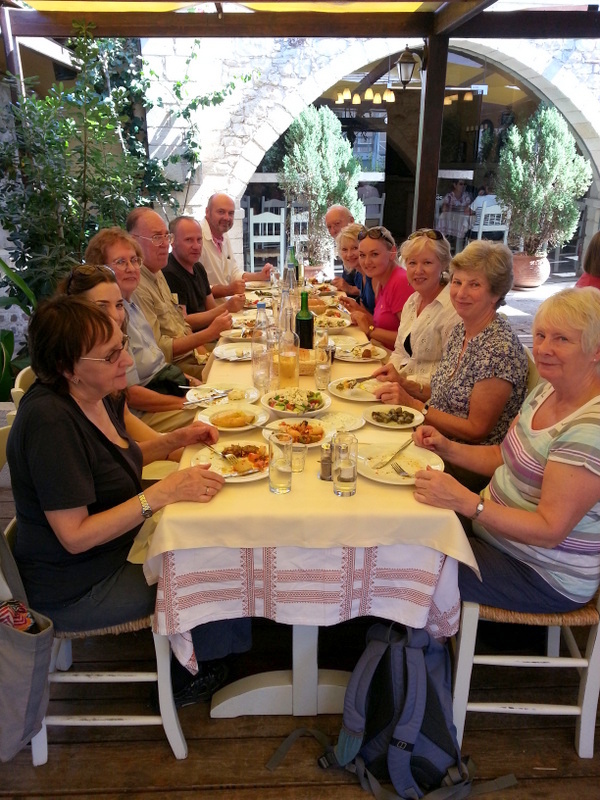
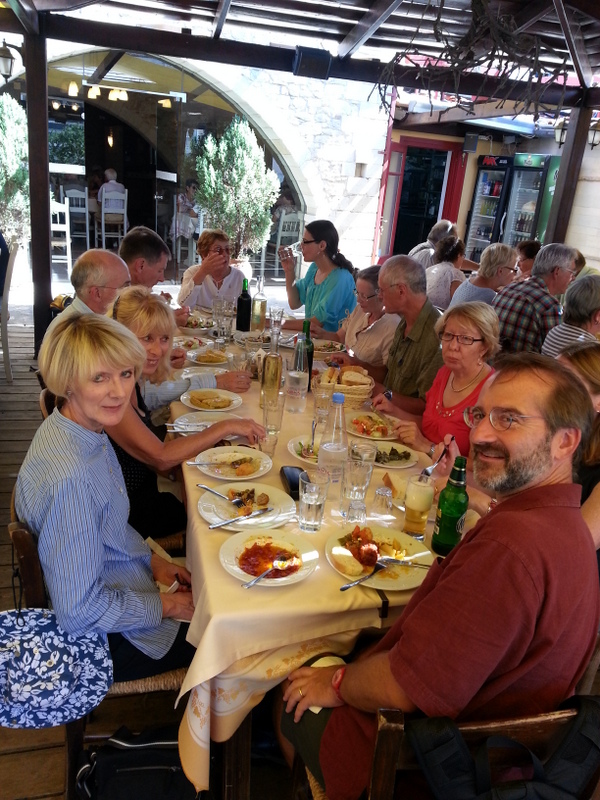
Luncheon with the Tour Group

Luncheon with the Tour Group

Anne, Diana, Harris and Janice

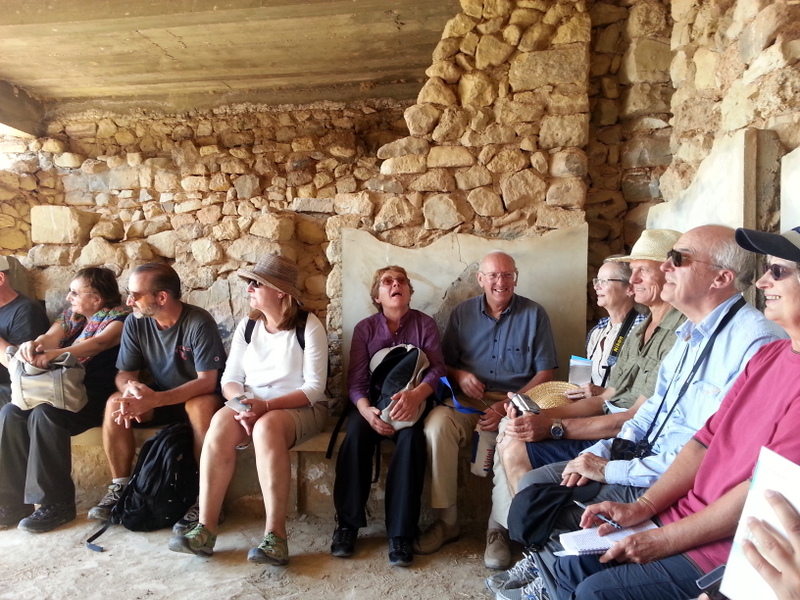
Our Tour Group

Our Tour Group

1-184-2013-09-28 07.37.04

Nona at Phaistos

Nona at Phaistos

Crete and Santorini — The Rise and Fall of Minoan Civilization

On Santorini overlooking the Caldera

On Santorini overlooking the Caldera

It’s actually been two and half months since the trip I took to Santorini and Crete with Andante Travels, taking an expert led tour of Minoan Ruins.  Akrotiri, the 16th Century BCE town buried in ash on Santorini, has been on my bucket list for years, but was closed during the 2000s due to the protective roof over the excavation having collapsed!  A new and stronger roof has been built and the site reopened in 2011.  So I’ve been champing on the bit to go there.   I’d been shopping for archaeological cruises by Voyages to Antiquity, National Geographic, Martin Randall for a couple of years.  We — my friend, Andrea, and I — found Andante Travels at the last minute and I’m so glad we discovered this tour company.  We had a blast!  It was everything I hoped it would be.  My two traveling companions were Andrea and my daughter, Iphigeneia.  Andrea and I had planned to travel together to Europe when our daughters had graduated from highschool.  We missed that deadline — although she has more daughters than I and one of them has yet to graduate — but our adventure was none the less exciting for that.  (We had great fun planning our wardrobes (not that you will be able to tell from the pictures of me). We started in London, having had a few days to knock around the museums and spend a day or two in Oxford — more on that in another blog — arriving at Gatwick Airport in plenty of time.  There were stricter luggage weight requirements for the EasyJet flight to Santorini than there had been for our overseas flight.    I noticed during check-in that my bag weighed 21.9 kilos, over the 20 kilo limit, but nothing was said, no money was demanded – I later found out why – so we checked at the X-ray machines and began looking around for the “distinctive” Andante baggage tags (as advised by our pre-tour instructions).  Right away we found Janice.  I’d actually noticed her rolling duffle in the long check-in line, thinking it looked very archaeologically tourish and envying it.  Then we met Harmon and Nell, an American couple, who turned out to be from STOUGHTON, WISCONSIN!  We laughed about that.  Out of the 21 tour members, the only Americans were all from Wisconsin.  (There was one other from state side, Stanley, from Washington DC, whom we met later.)   We’d been told to look for our Tour Guide, Gudrun Schmid, before going through to departures and finally located her over by the check-in area.  She was tall, dark haired and handsome.  I will just mention at this point that she wore embroidered Pakistani tunics throughout our tour (along with supplex nylon zip-off pants) for their length and they became her very well.  She said she traveled so often in Muslim countries, she’d found these airy, pretty tops a perfect solution to being covered up (a good tip for travel buffs).  Harmon was tall and consistently wore supplex nylon shirts and pants and a brimmed hat, which so reminded me of my late husband, Matt.  Matt would have loved our company of travelers.  (This is, by the way, perfect gear for an archaeological tour.) We were delayed in London by weather, so it was after nightfall that we arrived in Santorini.  We didn’t see one of the spectacular sunsets that are so famous.  Our lecturer, (Alexander) Sandy MacGillivray met us at the airport, along with our Cretan Guide, Mania, and they swept us off to our two hotels, one for doubles, the other for singles, and then to dinner at a local tavern overlooking the caldera, which we couldn’t see unfortunately.  (I imagine it had been specially chosen for the view and the sunset.)  I will interject at this point that Santorini is a volcano.  About 1600 or 1550 BCE it erupted spectacularly, then collapsed into the sea, leaving a crescent shape surrounding a fantastically deep caldera.   It is that view overlooking the caldera and two small, still active volcanic islets, that one sees so frequently in pictures of t he Greek Islands.

When we’d arrived at the Kalimera Hotel, I’d gone immediately to Gudrun and asked her whether she could help me get a “very quiet” room.  I’m not sure rooms were assigned yet, but the concierge immediately assigned Geneia and I to Room 18, which was way at the back, away from the road, on the other side of the pool, and had an adorable little courtyard attached.  I slept like a top and afterward left two dresses I was planning to wear in Crete in the closet, of course.  Doesn’t everyone do something like that when they’re traveling? Sandy was quiet-spoken and dryly humorous.  He wore a sort of uniform every day, a white, airily woven shirt, a bandana, pants and several small-brimmed hats.    He became our constant companion on the trip, both instructing and socializing.  He must enjoy people because he rarely got a break from us and didn’t seem to be chafing at it.  He was the soul of unflappability, intelligent conversation and kindness.

Sandy MacGillivray

I can’t recount what we ate the first night.  The food was always good and there was always local wine, both red and white.  That latter was a very nice feature indeed.  We usually had starters, ground fava beans as a spread, deep-fried squid or calamari, deep-fried goat cheese – that was heavenly – and bruschetta with tomatoes, herbs and feta ( tomatoes and cucumbers were abundant in different forms).  The main course could be fish or lamb or chicken.  For dessert there was often Greek yogurt with fruit.  Pastries were served with breakfast.

Greek Salad of Tomatoes, Feta, Capers and Herbs

Greek Salad of Tomatoes, Feta, Capers and Herbs

The first day started out with what could have been the severest blow.  We had breakfast and took the bus to Fira to see the Archaeological Museum and the Prehistoric Museum, before going to Akrotiri to tour the ruins and found that THE GREEKS WERE HAVING A STRIKE!  ALL THE ARCHAEOLOGICAL SITES WERE CLOSED! I was stunned as Gudrun, Mania and Sandy put their heads together to come up with Plan B.  I’d come on this tour for the express purpose of seeing Akrotiri.  I have to say that I didn’t unravel (pat, pat), although ideas of hopping the fence did occur.  There was still a hope that we would see it on our half-day on the morrow – the strike was only supposed to be for two days and this was day two – but we wouldn’t ever get to see those museums.  (I comforted myself with the thought that the actual Akrotiri frescos are in Athens.) Plan B became a voyage to the active volcano on two islands in the middle of the caldera.  Nea Kameni and Palia Kameni, which mean “the new and the old burnt out islands.”  (Sandy had related the comforting news at dinner the night before that there was an “unresolved” build-up of lava in the island beneath us that hadn’t been released in a big way since 1500 BCE.   Santorini is still a live volcano!)    I hadn’t worn my hiking boots, thinking we were going to museums.  Nea Kameni turned out to be an uphill hike on crumbled lava leading to an older and newer caldera.

Hking up to the Caldera on Nea Kameni

Hking up to the Caldera on Nea Kameni

There were vents emitting sulphurous gas along the way, which I found pretty interesting (after having read Pompeii by Robert Harris about the Aquarius, or aqueduct engineer, in the days leading up to the eruption).

Sulfur Vent, Nea Kameni

Sulfur Vent, Nea Kameni

Caldera, Nea Kameni

Caldera, Nea Kameni

Pools of sulfur within the Sea

Pools of sulfur within the Sea

Sandy pointed out the sulfuric pools in the Aegean around the island.  Venetian ships used to moor there to kill the barnacles adhering to heir hulls.  The Aegean was impossibly blue.  The reason you see all those domed roofs and doors painted brilliant blue in postcards (see above)

is because the color matches the Sea.  It’s almost unbelievable.  I longed to dive in, especially when our second stop turned out to be hot springs at Palia Kameni.  Most of the other passengers were wearing swimsuits and jumped off the boat, as they’d known they were coming.  We got our chance to swim later though.

Waiting for the boat to Nea Kameni

Waiting for the boat to Nea Kameni

While the Guides were purchasing tickets for the cruise, we had a chance to do some shopping.  Caryn had asked me to bring her back some Greek textile from which she could make a pillow.  One shop had actual pillow covers that were so beautifully needle-worked that I could hardly choose from among them.  I finally narrowed it down to two, one for me and one for her, not knowing which I’d keep myself since I thought them both so gorgeous. I also saw a silver bee pendant that was in my price range, but passed it by because it just isn’t the same if it’s not gold.  Then, just before the voyage, I found one in gold (see below, the real thing)!  The shopkeeper quickly wrote down the price in Euros and Dollars so I could contemplate the expense.  When we debarked from the cruise ship and took the gondolas back to the summit of the caldera, I quickly ran in and bought it.  Apart from the textile for Caryn, I had had in mind when we booked the tour, that the only souvenir I would buy myself in Crete would be a replica of that pendant, which I’ve loved all my life.

The Bee Pendant from Mallia

The Bee Pendant from Mallia

We got our chance to swim in the Wine Dark Sea that very night.  Our group was to walk down to the shore from our hotel and eat dinner at a tavern dug into the volcanic tephra.  Sandy offered to walk down an hour early with us for a swim off the pier – it’s a harbor.  We were joined by Joe and Elaine, two of our favorite people on the trip.  Joe was a great swimmer.  He was raised in Saudi Arabia and returned to the Middle East for work later.  He and Elaine had met at college in Belfast, Ireland.  It was nearly twilight, so we didn’t have the joy of leaping into that crystalline blue aqua, but it was warm and very salty.  The saltiness was a bit of a shock.  I mean, I knew it was salt-water, but it was salty enough to gag you if you swallowed it.  When the others arrived, we were sitting on the patio being introduced by Sandy to Raki, a distilled Greek spirit made from grape skins.  (I was missing vodka and it was the nearest thing.)  I quite liked it.

The Wine Dark Sea

The Wine Dark Sea

On day two, we headed to the ruin of ancient Thera, a Greco-Roman city perched on the height of an enormous hill overlooking the sea and named after the mythical ruler of the island, Theras.  (Santorini’s ancient name was Thera.   Thera is also the official modern name of the island, having been revived in the 19th century, so it’s a little confusing, because this ruin is called Thera too.  Most people know the island by the name Santorini, which  is derived from Saint Irene.)  It was another steep climb.  This time I wore hiking boots with my khaki skirt (see below; Elaine is also in the picture).

Nona at Ancient Thera in my Trusty Khaki Skirt and Broad Brim Hat

Nona at Ancient Thera in my Trusty Khaki Skirt and Broad Brim Hat

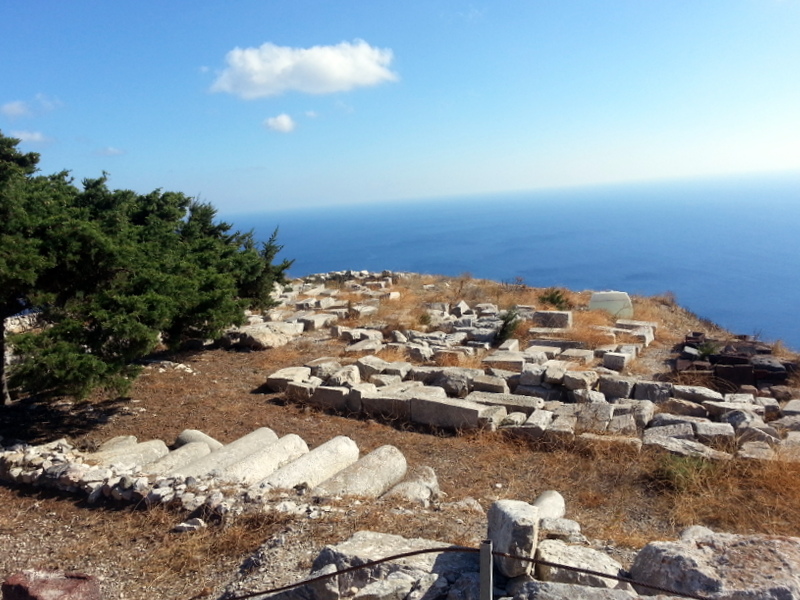
Sandy taught us to “scrottle,”  his (? probably shared by his cronies) unofficial term for potsherd and coin hunting.  Up until that time I’d hardly noticed that the ground was literally littered with potsherds.  I’d thought they were little terracotta pebbles, but no!  He picked up the handle of the cup to show us what was lying about and from that point on we all became avid scrottlers.    Thera was inhabited from the 9th Century BCE to about 728 CE.  Highlights were a theatre, stoa, agora and temples to imported Egyptian gods during the Roman era.   We all wondered at the height of the hill and how fisherman and tradesmen could bear to hike down to the sea, then hike back up with their sales goods.  It would have been so arduous.  Piracy, however,  was a real threat to islanders for most of the Aegean’s history once the Minoan Thalossocracy (rule of the sea) was destroyed with their fleet by the eruption of Thera.  The sea was not safe again until Roman times!

Thera, built on a Hill above the Sea

Thera, built on a Hill above the Sea

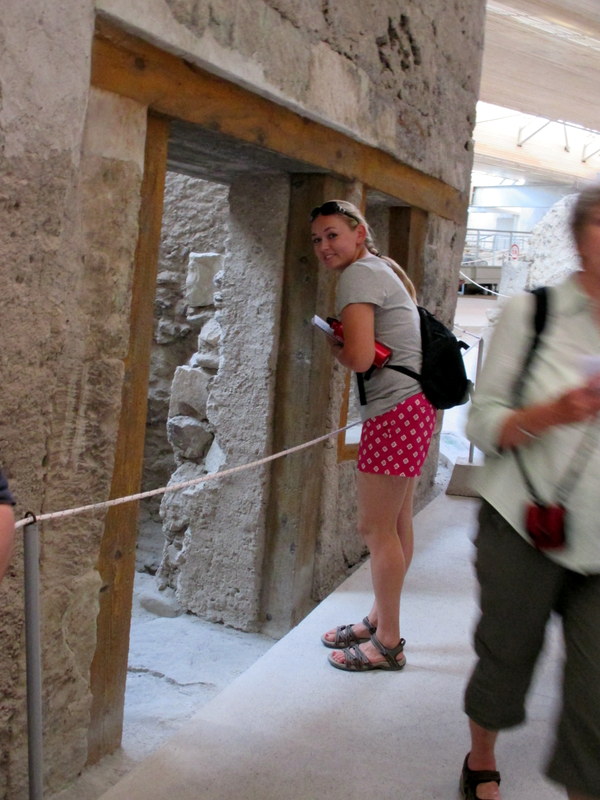
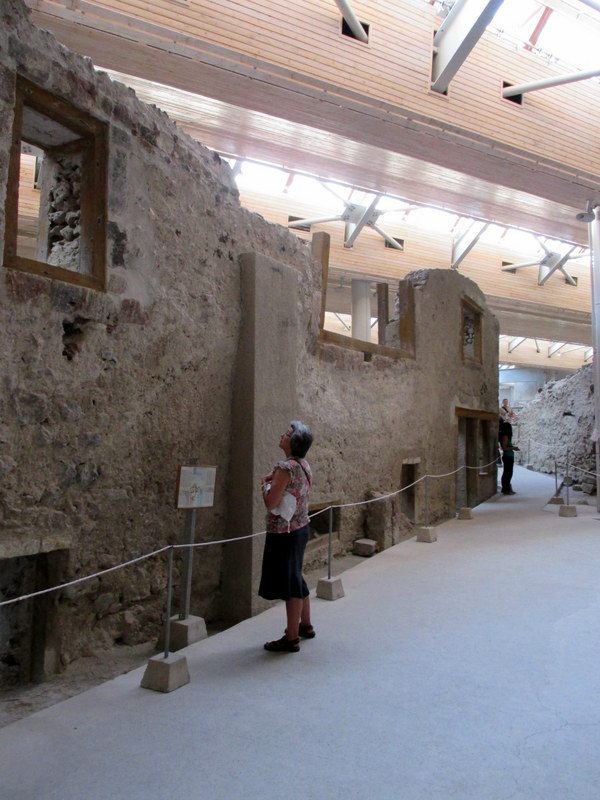
Then, ….we went to see Akrotiri.  The excavation is more extensive than one sees in pictures, and it was absolute thrill to walk through an ancient Minoan city and orient oneself to the space, the height of the doors and windows, and imagine what it might have been like to live there.

Akrotiri, destroyed around 1550 BCE, and buried in Ash until the 1970s, a World Heritage Site

Akrotiri, destroyed around 1550 BCE, and buried in Ash until the 1970s, a World Heritage Site

Elaine with the walls of houses at Akrotiri Geneia at Akrotiri Portal Akrotiri Doorway Main Street?

Akrotiri, destroyed by the Stupendous Eruption of Thera around 1550 BCE, a World Heritage Site

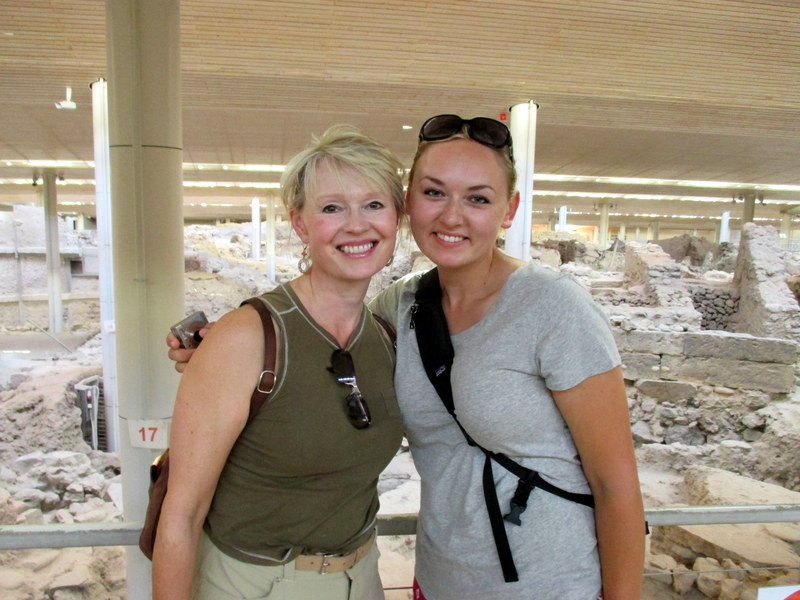
Nona and Geneia at Akrotiri

Nona and Geneia at Akrotiri

One thing more ticked off my Bucket List! Sandy met and introduced us to two colleagues, the world’s expert on Horns of Consecration, a common and controversial architectural feature of Minoan architecture, and an archaeological artist.  (I asked Sandy whether archaeology still employed artists or whether that was an outdated practice and he said that artists were employed on every dig.  Detail could never be recorded as clearly by photography as by drawing.  Most archaeological artists start out as artists, not as archaeologists.  Mmmmm…I should have looked into this earlier.) From Santorini, we took a catamaran to Heraklion, a voyage of about four hours. I sat next to Diana, who became another of my favorite people on the tour.   She works for Scotland Yard.  She dressed very femininely, unlike the rest of us, barring Andrea, no practical supplex for this girl!.  Diana was FUNNY!  I asked her why she always sat in the sun and wore clothes that offered no sun protection and she said it was because she worked in “black box, dear.”  She was dying to get out!  Her trenchant, comical evaluation of things was a constant delight. Our Hotel, Hotel Lato, was right downtown.  I was concerned about the noise, but once again went straight to the desk with Gudrun and was switched with another couple for the quietest room possible.  Once again I slept soundly both nights.  Sandy walked us down through the streets of Heraklion, pointing out the Venetian architecture and the Lion Fountain (see below), which is no longer running, but is a favorite local area to meet and congregate in.  We had dinner in a sort of covered market lined with cafes, where the tables and chairs were in the street.  I remember what we had that night.  It was the fried squid appetizers and wonderful lamb chops.

Here is the Venetian Landmark by Night, as we saw it

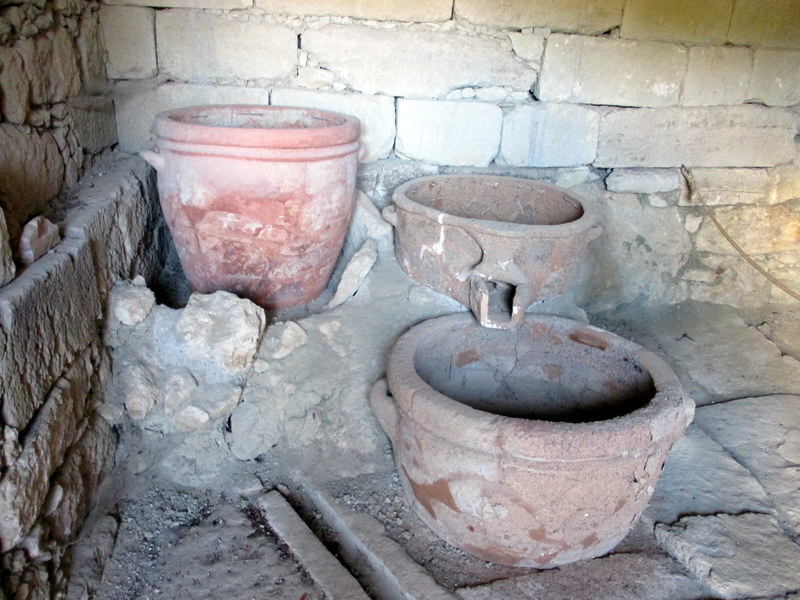
Each day there was a bit of rescheduling as the guides tried to avoid crowds at the more popular sites.  We had been scheduled to see Knossos first thing in the morning, but they learned that four cruise ships would be decanting their passengers that morning and the site would be mobbed, so after a short stop at the Heraklion Museum to see the highlights of Minoan art, we drove to Vathypetro, which was perhaps a country estate, located on a hill – let’s face it, everything in Greece is located on top of a hill – amidst vineyards and olive groves. The Vathypetro complex was constructed around 1580 BCE at the beginning of the Late Minoan IA period and badly damaged around 1550 BCE, perhaps by an earthquake. The south sector of the building, which includes a wine press, was rebuilt as a farmhouse and industrial center after the 1550 BCE destruction and was finally destroyed around 1470 BCE.  I was familiar with it from watching Bettany Hughes’ (my alter-ego) television documentary Island of the Minotaur, which I recommend as a very good synopsis of what we know or speculate about the Minoans.  (I’m currently reading her Hemlock Cup, which is a fascinating picture of the Athens that Socrates frequented and was condemned by.  It’s full of illuminating details, just as is her excellent Helen of Troy, one of the best books on the Bronze Age I’ve read.)  The site appears to have been self-sufficent:  local potter production is attested by two potters’ wheels and a kiln; numerous loom weights and spindle whorls testify to textile production.  Vathypetro has an intact wine press, one of the oldest in the world.  I thought at the time that I was going to love Vathypetro more than any of the other sites due to its beautiful setting and state of preservation.  Now it is hard to pick a favorite, but the setting of this site is gorgeous.

Geneia and Nona at Vathypetro

Geneia and Nona at Vathypetro

The Wine Press at Vathypetro

The Wine Press at Vathypetro

One of the points Sandy made at Vathypetro was that the ancient sense of time was circular rather than linear, as we conceive it.  I’m not sure what that really means.  He also pointed out that 1/3 of the days of the year were devoted to religious festivals.  It reminds of the medieval Church Calendar.  Medieval Europe and Crete were both agrarian societies.  We know that the Roman and Byzantine Churchesadopted pagan festivals and assigned them new names to make them appear Christian.  Might we derive a sense of what these religious festivals were like by the  survival of rituals in the medieval church?  He pointed out that the villa of Vathypetro had been expensive to build, had been preplanned with drainage etc. and that it was built to last.  One of the interesting features of the site is a Pillar Crypt or man-made cave.  Of course there are many natural caves on Crete that were used for religious rites and offerings.  Sandy theorized that the Pillar Crypt was used for sensory deprivation, nothing to see or hear, and some sort of maturation rite.  There are terracotta figurines of goddesses wearing poppies as a crown.  Might opium have been used to achieve visions in such a crypt? After Vathypetro, we stopped at the Archanes Museum for a quick look around.

At the nearby sanctuary of Anemospilia, on the north slopes of Juktas (mountain), four human skeletons were found in its ruins; one, belonging to a young man, was found in an unusually contracted position on a raised platform, suggesting that he had been trussed up for sacrifice, much like the bull in the sacrifice scene on the Mycenaean-era Ayia Triadha sarcophagus.

A bronze dagger was among his bones, and the discoloration of the bones on one side of his body suggests he died of blood loss. The bronze blade was fifteen inches long and had images of a boar on each side. The bones were on a raised platform at the center of the middle room, next to a pillar with a trough at its base.  The positions of the other three skeletons suggest that an earthquake caught them by surprise—the skeleton of a twenty-eight-year-old woman was spread-eagled on the ground in the same room as the sacrificed male. Next to the sacrificial platform was the skeleton of a man in his late thirties, with broken legs. His arms were raised, as if to protect himself from falling debris, which suggests that his legs were broken by the collapse of the building in the earthquake. In the front hall of the building was the fourth skeleton, too poorly preserved to allow determination of age or gender. Nearby 105 fragments of a clay vase were discovered, scattered in a pattern that suggests it had been dropped bythe person in the front hall when he was struck by debris from the collapsing building.The jar appears to have contained bull’s blood.  (Italicized content from Wikipedia)  Bettany Hughes suggested that the jar being carried away from the room contained human blood.  There is also the suggestion that human sacrifice was underway to avert the very earthquake that interrupted it. In the “North House” at Knossos, the bones of at least four children (who had been in good health) were found which bore signs that “they were butchered in the same way the Minoans slaughtered their sheep and goats, suggesting that they had been sacrificed and eaten. The senior Cretan archaeologist Nicolas Platon was so horrified at this suggestion that he insisted the bones must be those of apes, not humans.”  The bones, found by Peter Warren, date to Late Minoan IB (1580-1490), before the Myceneans arrived (in LM IIIA, c. 1320-1200) according to Paul Rehak and John G. Younger.   Dennis Hughes and Rodney Castleden argue that these bones were deposited as a ‘secondary burial’. Secondary burial is the not-uncommon practice of burying the dead twice: immediately following death, and then again after the flesh is gone from the skeleton. The main weakness of this argument is that it does not explain the type of cuts and knife marks upon the bones.  (again, Wikipedia)  Bettany Hughes relates the evidence and succession of events that preserved the evidence in Island of the Minotaur. We had a lot to discuss at dinner.  It was our free night.  Sandy was offering to take anyone interested down to the Heraklion Yacht Club for dinner.  Evidently they are famous for preparing a sort of small fish.  In spite of that menu billing, I would normally have leapt at the chance to go on discussing Minoan religion and burial practices – both scholars and members of the tour were suggesting that the Minoans practiced excarnation, exposing their dead on the hillsides to be picked clean by the Lammergeiers (see below) we often observed soaring above our heads – but I was feeling tired, not physically, but emotionally, from exposure to so many new and interesting sights and thoughts.

Before dinner, as a culmination of our day, we went to Knossos for about three hours.  I’ve been to Knossos before, at the end of 1975, between Christmas and January, when Harry Kampert, Vicki Bailey and I met the St. Olaf Roots of  Early Christianity Group in Istanbul.  It had been nearly deserted at the time, as the weather was rainy, and we’d been able to wander at will through the entire site.

Knosso in the Setting Sun

Knosso in the Setting Sun

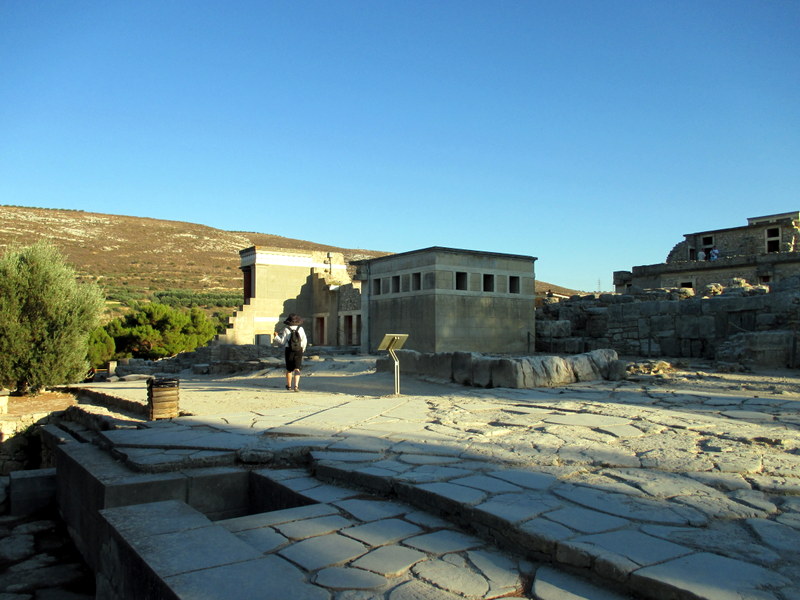
I hadn’t really remembered the scope of it though.  It’s BIG!   Sandy took us through it in the way that visitors would have entered to participate in a festival.  The current thinking is that Knossos was more of a community center than a “palace,” although Evans’ description has stuck.  There is no iconography of rulership here, or anywhere for that matter, in Minoan architecture.  Thrones are most generally occupied by women, priestesses, and picture a religious or ritual activity.  The famous Labrys, or double-ax (referred to as the “double-headed doo dah” by Terry, another member of our tour, and known henceforward by us by that name) is generally pictured hanging upside down, often from some sort of tray.  This double-headed ax was once thought to be the instrument of sacrifice for a religion centered on the bull, the natural presupposition of Sir Arthur Evans who had the myth of the Minotaur in mind.  That idea has been abandoned.  Also, by the way, Sandy thinks that the alluring, frilled dresses that women are invariably portrayed in are just the way Minoan women dressed.  I asked.  It seems so impractical a costume.

It must be the reason why Minoan Crete hasn’t been widely adopted by hobbyists for historical recreations.  Haha.

Throne Room, Dolphin Fresco, Stairway to Lustral Basin

Throne Room, Dolphin Fresco, Stairway to Lustral Basin

Fresco Recreated -- the dolphins would have been on the floor Knossos -- the Throne RoomThrone Room, Stairway to a Lustral Basin, where Priestesses prepared themselves, and the Dolphin Fresco, which actually used to on a Floor in the Room Above

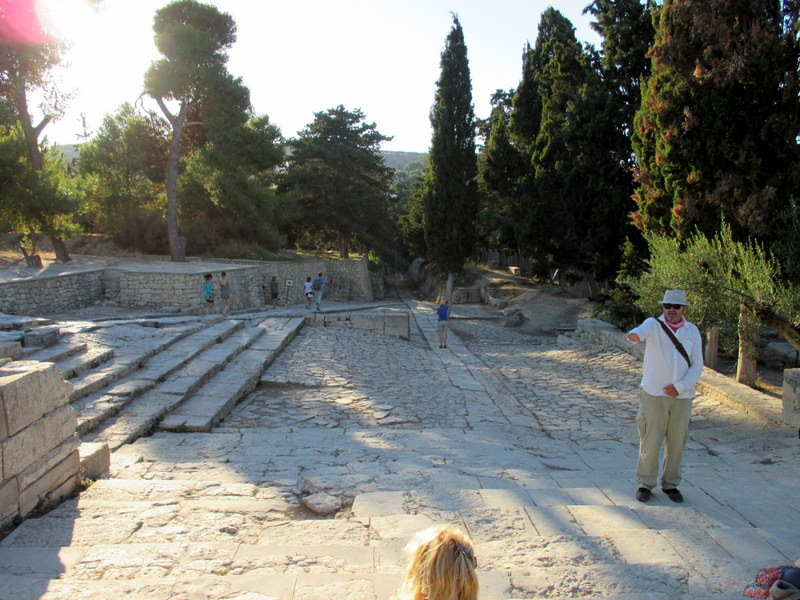
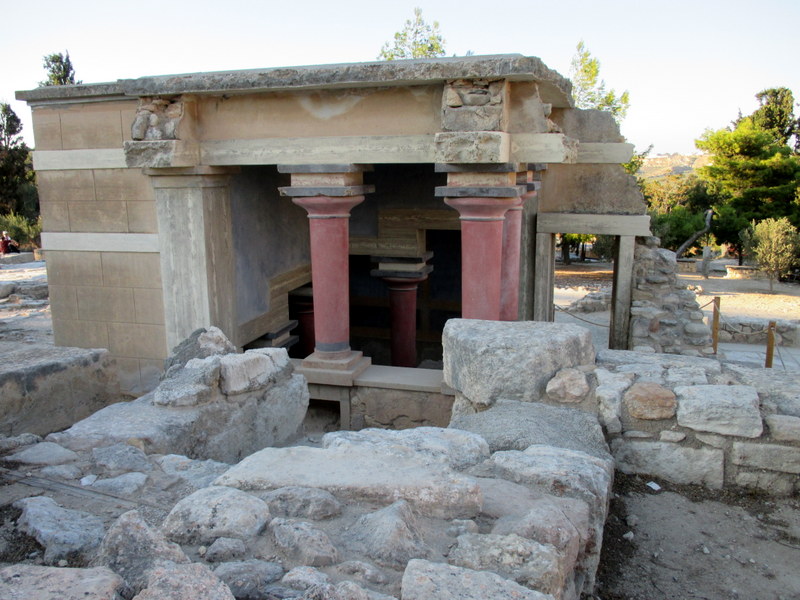
Knossos Knossos Geneia at Knossos 1-1-IMG_0590-001 Entrance with charging bull Sandy at Knossos Who goes there? Sandy, Knossos Andrea at Knossos Knossos The gorgeous pavement with the pink grout

A couple of the pictures above bear commenting on:  One of them shows the Pier and Door construction characteristic to Minoan architecture.  The recesses of the deep walls and doorways allowed folding doors to be opened and tucked inside the doorways or closed to protect from weather.  Immeditely above is the Processional Way into the palace.  The paving stones are blue and the grout is pink.   Another feature of the palaces are the Theatral Areas, wide steps with a courtyard at the bottom.  People would sit on the steps to observe whatever was taking place in the coutyard.  Sir Arthur Evans named the Theatral Area of the Palace of Knossos, the “Dancing Floor of Ariadne,”  so…..

The Dancing Floor of Ariadne

The Dancing Floor of Ariadne

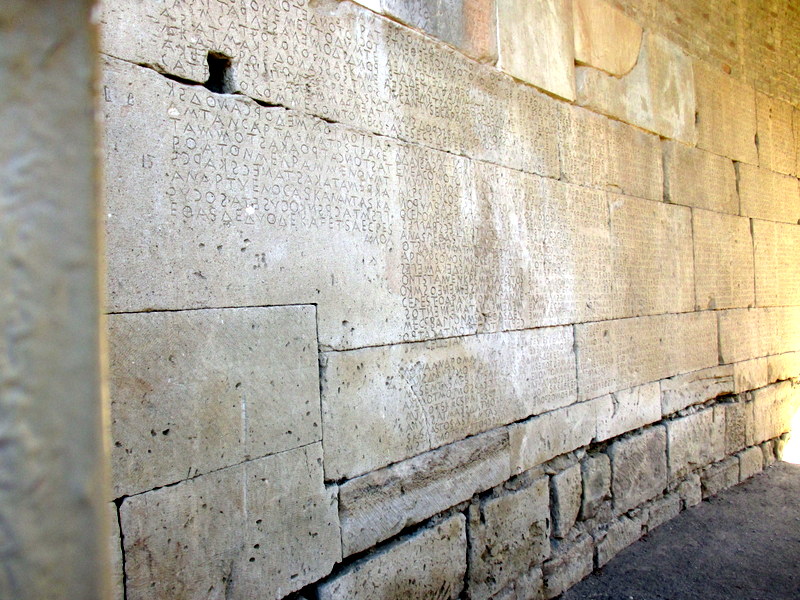
It was incomparably richer experience to visit Knossos with a knowledgeable guide who could make sense of everything you saw and tell you how the entire structure worked for its inhabitants.  Over and over again I felt confirmed in my choice of a  theme-tour  for a vacation.  We could never have gotten so much out of visiting these sites on our own.  Sandy has excavated on Crete all his life and is intimately familiar with the digs.  Also, by the way, it was great to be taken care of and not to have to expend OUR mental energy on finding good places to eat and stay the night, arrange for transportation, or have to lug my awkward, heavy duffle up and down the narrow streets of virtually anywhere in Greece. I was ready for a real vodka and cranberry at the end of my day…Ah divinity.  We dressed and went up to rooftop restaurant, open to the sky with a panoramic view. The next day, which was Saturday, we visited Gortyn, a thriving from Homeric times through Roman, famous for the Archaic-era  Gortyn Law Code, which was inscribed in stone.  Later Hellenistic construction reused the great blocks higglety-pigglety in one of their buildings. The site was abandoned in the 7th Century AD due to Arab rades, but during Roman times it was the most important city on the island, the capital of the Roman province of Crete and Cyrene (in Libya) from 27 BCE.   I think I have some potsherds from Gortyn.  There is a sanctuary of the Egyptian Gods wherein Serapis, Isis and Anubis were worshipped.

Gortyn, Greek Torso of a Young Man, Theater, Reused Stones of the Law Code of Gortyn

Gortyn, Greek Torso of a Young Man, Theater, Reused Stones of the Law Code of Gortyn

Theater at Gortyn Gortyn Remnant of the Law Code of Gournia

Next stop was Ayia Triada, another Bronze Age Villa, where a famous sarcophagus, referred to above, was found.

All this time we were busy scrottling.  Ayia Triadha and the nearby “palace” of Phaistos were reached by driving through the extremely scenic Mesara Plain.  I have pictures of this plain from my first visit to Crete, one day of which we spent touring Phaistos, Zakros and Mallia by bus.  Now I can identify my old pictures of this gorgeous topography.  The sites are related and situated on opposite ends of a single ridge.  As I’ve said, Phaistos is a palace akin to Knossos, though not as large.  Agia Triadha is town with possibly a “royal” villa.  According to mythology, Phaistos was the seat of king Radamanthus, brother of king Minos, who was later thought by Greeks to have become a judge in the underworld. It was also the city that gave birth to the great wise man and soothsayer Epimenidis, one of the seven wise men of the ancient world. The Royal Villa was built at the end of the Middle Minoan period (MM IIIB) or possibly in LM IA, possibly as late as 1550 BCE. It was destroyed by fire in the generalized destruction of 1450 – when the Myceneans apparently took violent possession of Crete — so it was in use for between 100 and 150 years at the most. Its existence has been explained by some as a “Summer Palace” for the “King” of Phaistos or other important officials. Others have argued that Agia Triada was the seat of a local chief.  As I’ve already mentioned, there is a lot of controversy about the use of these “palaces.”  Agia Triadha’s identification as a royal villa stems from the monarchist school of thought.  Agia Triadha’s Minoan ruins are topped by a Mycenean megaron.  (Chania in Western Crete show the first Mycenean warrior burials.) There are a couple of interesting features of the palace at Phaistos.  One is two steps about four feet high in the corner of the Central Courtyard from which, it has been suggested, acrobats used to leap over bulls.  This isn’t entirely speculation.  There is actually a seal-ring picturing just such a feat, from just such a platform.

Bull Leaping Platform in the Corner of the Great Courtyard at Phaistos

Bull Leaping Platform in the Corner of the Great Courtyard at Phaistos

The picture above is from one of the informational plaques at Phaistos.

1-1-IMG_0686The Actual Stone Platform

Geneia and I have talked about the whole bull-leaping thing during and ever since the trip.  Most experts have pronounced the feat impossible, at least as portrayed in Minoan iconography (see below).

If they weren’t actually leaping over bulls, the frescos and many sculptures portraying it could be relating a mythical narrative central to Minoan religion.  The same is true of the monkeys gathering saffron and the Mistress of the Animals and other fresco themes.  We’ve simply lost the “story,” and so don’t understand it.  That seems feasible, but considering that the Myceneans took over the Minoan sites, I find it difficult to believe that some vestige of a myth that featured bull-leaping didn’t survive to explain the pictures as a story.  I frankly believe – and Geneia recognizes that she WANTS to believe – that the Minoans were actually leaping bulls.  There are so many pictures of it and they all look alike.  There’s someone at the horns and a spotter at the rear and a figure somersaulting frontwards over the bull’s back.  Now, there is a current sport of bull-leaping in which the athlete leaps the bull side-on, but not a single Minoan illustration suggests that it was ever done any other way than head-on.

Bull Leaping Fresco from the Palace of Knossos

Seal Ring with Bull Leapers — not the One showing the Platform though

Sandy also suggested an astral explanation of the Bull Leaping fresco in which the figure grasping the bull’s horns is Orion, the bull is Taurus, who has swallowed the seven Pleiades, and is spotted by Andromeda.  It is the actual map of the sky.  It also supports the Minotaur myth in which the Minotaur ate seven maidens.  I think that’s interesting.  In Greek Mythology, Orion did pursue the Pleiades and Zeus transformed them into stars to escape his amorous pursuit.  There is no bull in the Greek tale though.  However, Michael Rappenglück of the University of Munich believes that Taurus is represented in a cave painting at the Hall of the Bulls in the caves at Lascaux, which he believes is accompanied by a depiction of the Pleiades.  The name “seven sisters” has been used for the Pleiades in the languages of many cultures, including indigenous groups of Australia, North America and Siberia.  (Wikipedia)  So, a bull might be provided there.

Bettany Hughes said that the bulls used by the Minoans were hybrid Aurochs.  Now, I first became familiar with Aurochs, the European bison, extinct since the 17th Century AD, from Quo Vadis, because the heroine Lygia was tied to the horns of one in the Colosseum.  I had to find out about them.

The proportions and body shape of the aurochs were strikingly different from many modern cattle breeds.  For example, the legs were considerably longer and more slender, resulting in a shoulder height that nearly equaled the trunk length. The skull, carrying the large horns, was substantially larger and more elongated than in most cattle breeds. As in other wild bovines, the body shape of the aurochs was athletic and, especially in bulls, showed a strongly expressed neck and shoulder musculature.  (Wikipedia)  Cows were red-brown; bulls red-brown to black.  They had a white dorsal stripe.  See below for size comparison with a human.

This has been photoshopped, no doubt, but it gives an idea

Sandy wasn’t familiar with aurochs, which rather surprised me.  He wrote it down to look it up.  He was familiar with Mary Renault, of course.  Mary Renault speculated in the King Must Die that the bulls used in Bull-Leaping were hybrids as well, to make them a little slower and little more stupid than a wild bull.  I have thought ever since reading Quo Vadis that the wild bulls referred to in the Bible, the paradigm of strength and power, were aurochs.

Part 2: Enter Dante Gabriel Rossetti and the other PreRaphaelites

Self Portrait by Dane Gabriel Rossetti


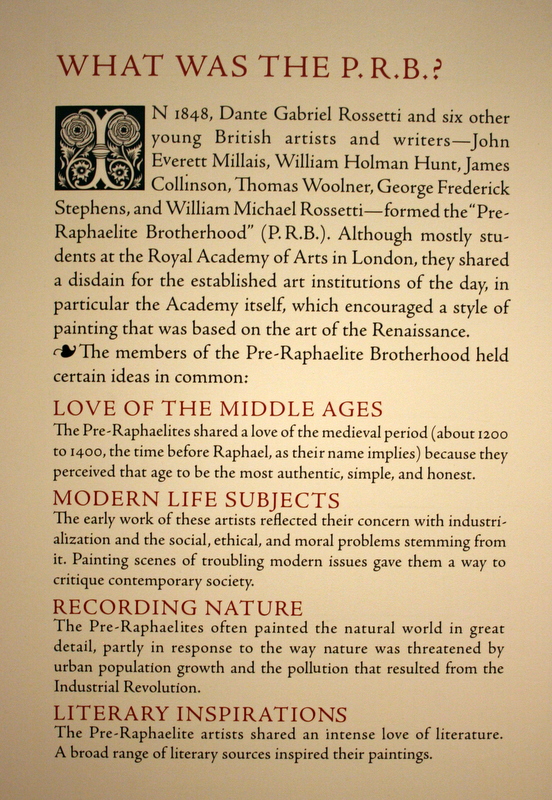
As a follow-up to The Beginning of the PreRaphaelite Brotherhood, which I blogged in May, I’m going on with the story of the friendship between seven artists who made up a secret society of artists in the Victorian era and whose lives were about as worthy of soap-opera as any could be.  Three of them are famous:  John Everett Millais, William Holman Hunt and Dante Gabriel Rossetti.  In my first installment, I wrote about how Millais helped Hunt enter the Royal Academy and found they shared ideals about the future of painting which were subversive by Academy standards, and how they decided to assail the establishment with paintings modeled on nature and real-life people.  This installment will be about how the third most notable became acquainted with them and contributed his own unique vision.  These articles are drawn from letters I’ve written to my friend, Julie Good Kruger, so please forgive the way narrative jumps about.

Gabriel Rossetti came from a creative family.  There was an Italian revolutionary poet as father and a mother with both common (economic) sense and a good education.  These kept the family afloat in respectability and launched the children in creative endeavor.  Except for the repressive, puritanical authority hovering in the wings of Yorkshire, the Rossetti children of London remind one of the Brontes, in that the children, Maria, Gabriel, William and Christina ensemble created a world of their own and entertained each other by turning out poems, drawings, plays and journals as their chief form of play.  According to Gay Daly  (The PreRaphaelites in Love),“this fruitful collaboration never stopped; all their lives they encouraged, advised, edited, and read proof for each other, creating a network of mutual support that helps to explain the startling range of their achievements.”  It’s enviable.

Gabriel and William Rossetti began going to school away from home at age 9, while the girls were tutored.  The girls insisted on equaling their subject range, but the chief difference in their experience henceforth was probably the boy’s exposure to the environment of London.  A contemporary French visitor to London in the 1840s and 50s wrote:  “I recall the lanes which open off Oxford Street, stifling alleys thick with human effluvia, troops of pale children crouching on filthy staircases; the street benches at London Bridge where all night whole families huddle close, heads hanging, shaking with cold; above all I recall Haymarket and the Strand at evening, where you cannot walk a hundred yards without knocking into twenty streetwalkers: some of them ask you for a glass of gin; others say, ‘It’s for my rent, mister.’  The impression is not one of debauchery but of abject, miserable poverty.  One is sickened and wounded by this deplorable procession in those monumental streets.  It seemed as if I were watching a march past of dead women.” ( Hippolyte Taine)

The misery surrounding them later helped galvanize the nobler goals of the young PRB and other artists and writers of the era.  The plethora of young women needing money, whose reputations were unlikely to suffer any worse by modeling than they already were from waiting tables at local taverns or prostitution, form another portion of the PRB story.  Elizabeth Siddal was an early exception, as she was respectably employed in a milliner’s shop.

At age 13, Gabriel entered Sass’s, the prep school for the Royal Academy Schools.  Due to Mrs. Rossetti’s money management, the Rossetti’s were not as poor as the Hunts.  Millais had breezed through and entered the Royal Academy immediately, but Gabriel, subjected to the usual regimen became bored and began to cut classes, pronouncing them “trivial, mechanical and death to the soul of the artist.”  He drifted around the city, exploring and writing poetry.  His brother William had sacrificed his dreams of becoming a doctor and taken a job as a clerk at the Excise Office to help support the family, Mr. Rossetti having suffered a series of strokes and being forced to retire from his position as professor of Italian at King’ s College.  Despite his scapegrace attitude, Gabriel was accepted at the Royal Academy – he was talented without doubt – but (again) he couldn’t bear to the mandatory two years of drawing from plaster casts before passing on to live models.

The merits of this system may no doubt be debated.  It must have proved vexatious to others besides Rossetti, but these others gritted their teeth and drew.   Gabriel was not unaware that his fellows were getting ahead, so he looked around for an artist to apprentice himself to, according to the medieval system, thinking it more suitable than the classical model.  The artist he settled on was Ford Madox Brown (who is frequently associated with the PRB in retrospect, though he was never an official member of the club).  Gabriel wrote him a letter of introduction, full of such lavish praise, that the thus-far-unsuccessful Brown showed up at Rossetti’s digs armed with a club, ready to deal Gabriel a blow for his impudence.  His petitioner was sincere in his admiration though and by the end of the interview, Brown had agreed to take him on without fee.

Brown wanted Gabriel to go through the same rigors he’d passed through himself in drawing and painting — the classical method – while Gabriel “wanted to surge ahead and embark on large, beautiful, extravagant paintings.”  The apprenticeship was proving to bear the same disadvantages as the Royal Academy.  However, at that point Gabriel met Hunt.  Hunt too had bristled at the classical method, but had all the same worked the grist.  He was inspired by Rossetti’s imagination and the two found a ready friendship in their visions for the future of art.  He agreed that Gabriel could bypass the usual training, because Gabriel was unusual.  (Also, Hunt was more accomplished than Rossetti, so there is little threat to himself in dismissing the requirements of the Royal Academy.  He, after all, had done the work.).

Here is one of Gabriel’s still-life exercises for Brown.  One can see the future Rossetti themes.  He is struggling to find something lovely and thematic in a simple still-life.

It’s called Bottles.

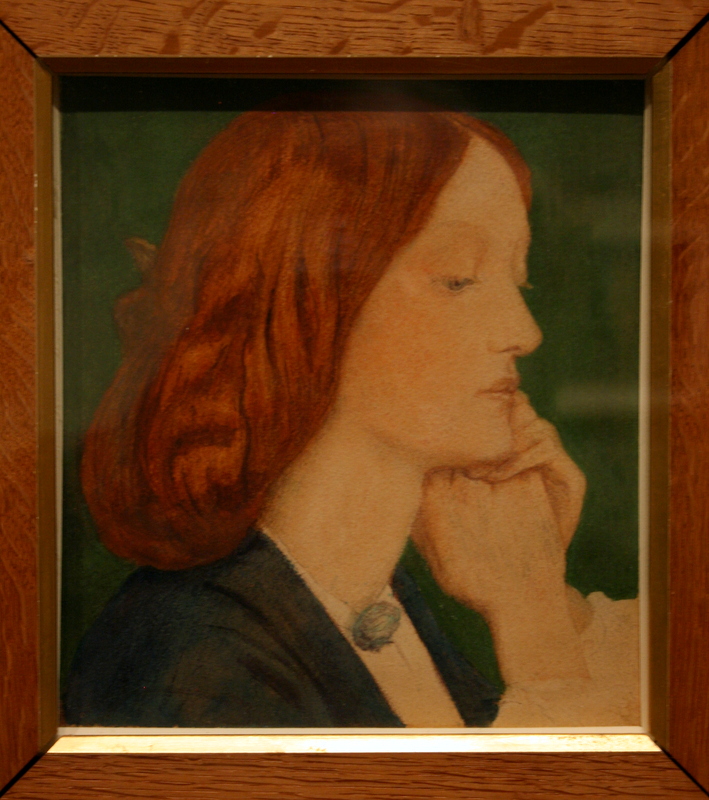
Elizabeth Siddal by Dante Gabriel Rossetti, 1855

I don’t know how much this bypass of classical training affected Gabriel’s art in the long run.  I’ve never thought him the equal of Millais or Hunt or many others, but this may be more an expression of taste than skill.  Gabriel’s drawings of Elizabeth Siddal and Annie Miller are very fine.   We’re most familiar with his lush paintings of beautiful women who in fact look much alike, differing mostly in costume and hair color.

La Ghrilandata by Dante Gabriel Rossetti

They are glamorous in that fantastical, sensual Rossetti way, but there is little story or drama or sense that one is looking at a real woman.  One can just recognize Lizzie or Annie or Jane Morris.  Rossetti did gain skill, but his paintings were more actually PreRaphaelite when they were still awkward.  Ultimately, he developed more of a kinship with the Aesthetic Movement.

That was a long way of saying that perhaps Rossetti was a painter of greater skill than I give him credit for.  I don’t like his artificial women, but cannot judge his capacity by that solely.


Study of Annie Miller for Fair Rosamund by Dante Gabriel Rossetti

When they met, Hunt had just sold his painting of The Eve of St Agnes and was in funds.  He moved out of his parents’ home and rented a studio for himself.  He’d intended to rent the space alone, but Gabriel convinced him to share the space and the expenses.  Hunt was afraid Gabriel would take up his painting time, but his new friend made live so exciting and fun, he agreed.

The two stayed up late, discussing all their enthusiasms.  They both loved Keats, who interestingly was little read or regarded at the time.  Gabriel introduced Hunt to Blake and here is a story worth noting:  Gabriel had purchased ” a notebook full of Blake’s manuscripts and drawings from an attendant at the British Museum, who apparently wanted to get rid of it because it was not worth cataloging.  (Gabriel had been broke at the time, but fortunately William had been willing to lend him the necessary ten shillings.)”  (Daly)  Thus do the creative spirits of the “present” rescue their kindred spirits from the past.   Like Gabriel, the romantic young Hunt had written poetry, but when Gabriel showed him his own poems, Hunt abandoned the medium.  Gabriel was so much better at it.  The new studio became a Mecca for a steady stream of visitors, enticed by Rossetti’s charisma and friendliness, and Hunt recognized with chagrin that hours and hours were being spent in conversation, however inspirational, that might have been spent painting.  Hunt could not be kept from working for long, but during this period of his life he yielded to his new friend’s companionship.  “Hunt confided the hope he shared with Millais of initiating a radical reform to bring painters back to the study of nature, the only true source of inspiration.”   (Daly)

Rossetti’s spirit must have responded to this ideal at once, but in practice the study of nature required a bit too much effort and Rossetti was an excellent talker.

Gabriel did attempt to paint from life during his sojourn with Hunt.  He began his Girlhood of Saint Mary for which his sister Christina modeled as Mary and his mother as Saint Anne.  As I said, painting from nature was one of the hallmarks of the PreRaph movement, at least as Hunt and Millais, its originators, were concerned.   This was just about Rossetti’s last attempt to paint a “homely” subject and persons as they really appeared, according to Gay Daly, although it seems to me that the unfinished Found is painted from life.   It’s Annie Miller after all.
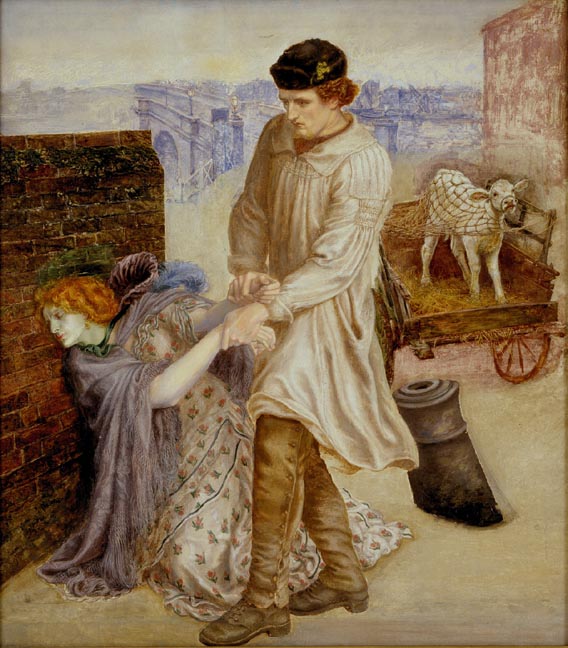
Found by Dante Gabriel Rossetti

Gabriel’s revolutionary spirit started to attract followers.  First, naturally, was his brother William, who began taking life-drawing classes in the evening.  Hunt looked at his “conscientious, although rigid transcriptions of the nude” with some dubiousness.
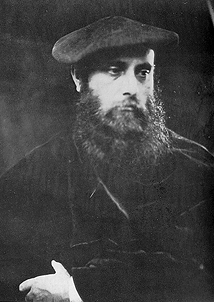
William Rossetti by Julia Margaret Cameron

As a second candidate Gabriel introduced Thomas Woolner, who had aspirations to become an important sculptor, but was at the moment employed carving marble decorations (which is certainly good practice).  Gay Daly describes him as cocky and self-important.  That might have irritated the modest Millais, when he again appeared on the scene, but talent certainly gives a cohort greater credence.  Henry Adams describes Woolner in The Education of Henry Adams as being a “rough” personality and having to make a “superhuman effort” to be polite.  Mmmmmm…..I might not have thanked Gabriel.
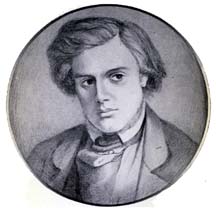
 

Thomas Woolner by Dante Gabriel Rossetti

Gabriel’s third recruit was James Collinson, Christina Rossetti’s suitor.
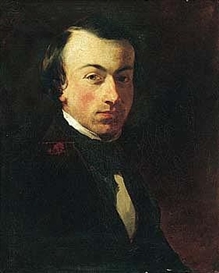
 

James Collinson

Collinson suffered from narcolepsy and had a tendency to fall asleep in the middle of conversations.

A pupil of Hunt’s named Frederic George Stephens was introduced as a sixth member (Millais being taken for granted, though absent).
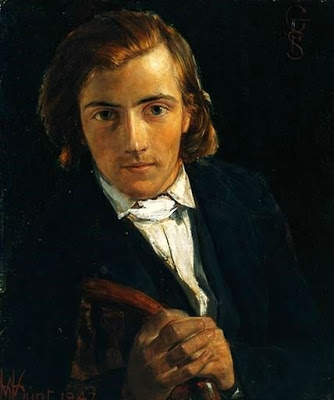
 

Frederic George Stephens by William Holman Hunt

Stephens was handsome and for that reason, I’ve provided two pictures of him.

Frederic George Stephens by John Everett Millais

He is definitely the one that Fred in a recent miniseries was modeled after.  He’d been lamed as a child, which gives an extra poignant fillip to his persona.  He was a student at the Royal Academy, but soon became discouraged with his talents and became an art critic instead.  The thing that is interesting is that he modeled!  He was the model for Millais’ Ferdinand Lured by Ariel and Jesus Washing Peter’s  Feet by Ford Madox Brown (see below).

According to Wikipedia, he communicated the aims of the Brotherhood to the public. He became the art critic and later the art editor of the Athenaeum while writing freelance for other art-history periodicals including The Art Journal and Portfolio. He also wrote for journals on the continent and the United States. His contributions to the Brotherhood’s magazine The Germ were made under the pseudonyms Laura Savage and John Seward. During this time he was heavily influenced by Dante Gabriel Rossetti, whom he allowed to write reviews of his own work under Stephens’s name.”

That sounds totally like the character in the Miniseries.


Ferdinand Lured by Ariel by John Everett Millais

Stephens supposedly destroyed all his paintings, but three survive (see below).  I’m happy to report that Stephens was successful in his consolation career and went on to become a respected art historian.  He didn’t approve of Impressionism when that came along, probably due to its marginal adherence to nature.

In spite of the resentment between Fred and Gabriel in the miniseries, the person who was most ungracious to Stephens in life was Hunt.  At a later date, Hunt was honeymooning with his second wife , Edith, the younger sister of his first deceased and canonized-by-her-family wife Fanny, and had asked Stephens to ship his art supplies to Jaffa.  He and Edith were going to live in Jerusalem.  The supplies didn’t arrive when expected and Hunt went into a frenzy, thinking the time lost from painting would ruin him.  He had to make do with what he could find in the meantime.  When he finally did receive notice that the shipment had arrived, to quote Gay Daly, “Dropping everything, he jumped on his horse and galloped over the mountains to Jaffa, where he was amazed to discover not his three packing cases but a single large crate.  He there spluttering on the dock as porters struggled to open it .  Eventually they


Jesus Washing Peter’s Feet by Ford Madox Brown

hauled out the three smaller cases, then a further twenty-eight parcels – the many additional items of houseware and apparel he had asked Stephens to ship in letters dispatched from Switzerland while he and Edit were honeymooning.  Hunt was angry because Stephens had been so stupid as to send such an enormous crate; he should have known that shippers along the way would leave it till last because of its weight.  It would have been clear to anyone else that Stephens had gone to extraordinary trouble to send every single item that Hunt had requested and to make absolutely sure that the case was strong enough to survive the depredations of any thief or fool.  From Hunt’s distress over the delay, one would think the crates had been years in transit; in fact this unthinkable delay had lasted five months.”  In the meantime, Hunt had begun the Triumph of the Innocents on a sub-standard canvas which caused him years of trouble.  The two men never really recovered from their resentment and a trivial matter a few years later broke the friendship for good.
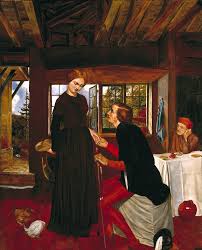
 

The Proposal (The Marquis and Griselda) by Frederic George Stephens

For my part, I think the fault was Hunt’s, and after all those years when Stephens played guardian over Annie Miller for him, all WITHOUT sleeping with her, Hunt should have felt bound in gratitude for his friendship.

As a result, “Hunt lost his lieutenant, his confidant, and his most uncritical critic.  The dozens of reviews and items about Hunt’s work that Stephens had supplied over the years to the Athenaeum, tantalizing the public with hints about works still on the easel and praising finished pictures as masterpieces, had done much to make Hunt a major figure on the art scene, and after the break they dwindled away.  In his autobiography Hunt dismissed Stephens bitterly as ‘my quondam friend.’”  There are many reasons why Hunt impresses me, but in this instance, I think he was an ungrateful wretch.

In the meantime, Millais returned from his summer in the country and was understandably hurt to find his friendship with Hunt hijacked by Hunt’s new best buddy, finding “his private dreams and cherished ideas for reform had been shared with a host of strangers who were planning to style themselves as artists when in fact some of them didn’t even know how to draw.”  (Daly)  He teased Hunt, “Where is your flock?  Are you getting up a regiment to take the Academy by storm?  I can quite see why Gabriel Rossetti, if he can paint, should join us, but I didn’t know his brother was a painter.  Tell me.  And there’s Woolner.  Collinson’ll certainly  make a stawart leader of a forlorn hope, won’t he?  And Stephens, too!  Does he paint?  Is the notion really to be put in practice?”  (Millais’ correspondence with W H Hunt)

I can well imagine his feelings.  There is the simple jealousy one feels at having made a best friend, then then watching them being charmed, perhaps even more, by someone new.  Millais and Hunt were very serious about their painting and were really the most viable members of the association.   It is testament to Millais’ personality, however – you see that I want to think well of him – that he soon fell in with the energy being generated.  He was quite social, so he succumbed to Gabriel’s charm…(Daly says) “for the moment.”

They focused on Raphael as the turning point in the history of art, not that they didn’t like Raphael, but since he had been a genius, his virtues had been formalized and become a straight jacket for artists ever after.  “To put painting back on track, young artists would have to drop the aesthetic styles and judgments of the past three centuries and throw off the deadly hand of the Renaissance.  They would need to return to the spirit of the early Italians who had worked with a simple, direct regard for nature….Giotto, Fra Angelico, Orcagna and Ghirlandaio….now dismissed as naïve.”  (Daly)

This is interesting.  One can see the combination of Hunt’s and Millais’ original reformatory ideas wedded with Gabriel’s love of the Italian.  They couldn’t have had much first-hand knowledge of Italian painters, because the National Gallery at the time had only a few.  None of these young men had traveled on the continent (as yet).  Their knowledge of the art predating Raphael was based on the few prints they had seen and on Ruskin’s descriptions.  So, there again is the galvanizing influence of Ruskin’s writings.  It was a slender knowledge base on which to raise a revolution, but it reminds me very much of my own callow experience in college.  Before going to school in England, I’d never been in an art museum in my life, never seen any great paintings first hand — I’d only been exposed by prints on calendars or books (and we didn’t have that many books).  These young men at least had genuinely great art on hand to view and they weren’t against everything they saw.

My first visit we paid to the Constable / Turner Exhibit was a huge experience for me, seeing all Turner’s  large early seascapes and the huge, impressionistic  oil sketches that Constable did before working out his studio landscapes.  I bought the largest stack of art cards I’ve ever bought.  They didn’t do the 8 foot long paintings justice, but I sent them to my parents trying to describe the difference.

Hunt and his companions met constantly in the evening, after the sun had set and painting was no longer possible.  In a month they had hammered out their ideas.  Millais invited them to his Gower Street studio for their first “official” meeting.

Millais brought out some engravings of the medieval frescoes in the Campo Santo.  Hunt held forth on the principles that would inform the group’s work, explaining that he, Rossetti, and Millais had settled on “the Pre-Raphaelite Brotherhood” as a name, not because they would imitate the early Italian painters, but because they would reclaim the innocence and purity that painting had had in those days.  Collectively they would eschew convention and escape the burden of rules under which artists now labored; instead, they would turn to nature as their master, not to copy it slavishly but to render their own perceptions faithfully.  At the same time they would commit themselves to painting themes that had moral value, that inspired those who saw their pictures to lead noble, decent lives.”  

Now for the manifesto, because every revolution needs a manifesto.  The PRB Manifesto, to which they all ascribed their names, was a list of their “Immortals”, those whom they chose to emulate, and it was divided into five categories.  “At Hunt’s insistence, Jesus stood alone at the top.  (Gabriel had wanted Shakespeare to have this spot.)  Category two contained Shakespeare and the author of Job.  Number three listed Homer, Dante, Chaucer, Leonardo, Goethe, Keats, Shelley, King Alfred (?!*), Landor, Thackeray, Washington (J) , and Browning.  Categories four and five…rang(ed) from Boccaccio to Mrs. Browning to Newton to Edgar Allen Poe.”   It may sound eccentric, but a list of one’s heroes is more flexible than a formal treatise and hence more human.

They also decided to meet monthly for a progress report, but thrived in each others company so much that they began getting together every night, after painting hours of course.  “Very young and very earnest, they laid down prohibitions against drinking, smoking, and swearing, although they seem to have drunk the occasional glass of beer, and Woolner at least always had a pipe in his mouth.”  I loved this incident:  “When Tennyson published In Memoriam, an elegy for his closest friend, Arthur Henry Hallam, William Rossetti arranged to get one of the very first copies to review.  Everyone gathered at Gabriel’s studio that evening, and when William arrived, brandishing the copy over his head in triumph, he passed it to Gabriel, who read the entire poem aloud – more than 2700 lines – while his friends sat listening intently.  Friendship was the mainstay of their lives.  Tennyson, already their hero, had spent fifteen years crafting this masterpiece from his grief for his friend Hallam, who had died at the age of twenty-two.  These young men understood its greatness in the moment, and felt privileged to have heard it read in their intimate circle.” (Gay Daly)

None of the Brothers was rich.  All seven were middle or lower middle class.  They were intent on bettering themselves economically and socially, but not by compromising their artistic principles.  “Until the early part of the nineteenth century, painters were generally regarded as little better than tradesmen.  The Royal Academy’s prestige was a recent phenomenon.”  Of course they were challenging the Academy head-on, so the path to adulation was going to be a rocky one.

The brothers no doubt thought about women, but “a man could not sleep with a woman who was not his wife – at least, he could not acknowledge (it)…A gentleman could not marry until he had sufficient income to support a wife in comfort, which meant hiring servants.  It might be years before any member of the Brotherhood had the sort of income a wife required, so it was easier to steer away from romance or even from friendship with women.  Even in the letters the PreRaphaelites wrote during this period, few women are mentioned, with the exception of mothers, sisters, and aunts.  Instead the young men threw themselves into their relationships with one another, forming passionate bonds that lasted, sometimes until death.”  (Gay Daly)

We know Rossetti was aware of women because he’d written a poem at age twenty one about the life of a prostitute.  “There is about it the shock and revulsion of a pure young man speaking about something that he affects to understand but has not in fact experienced.”

“Late night expeditions took the Brothers to Tottenham Court Road and other quarters where prostitutes waited for customers…looking not for sex but for models, and they examined the face of each woman in the hope that she would prove exciting to paint.”  In this they may have been encouraged by Rossetti’s experience – he had sketched prostitutes on the street as a teen, how close one does not know.  One can see them daring each other in jest, but with serious artistic ambitions, the finding of worthwhile models was a serious business.  “When they found a promising beauty, courage generally failed them.  Except for Gabriel, they could not bring themselves to ask a young woman if she would consider coming to the studio, so it seems unlikely that any of them had the nerve to venture out alone and pick up a woman for sex (especially Hunt, who wanted to become the world’s greatest religious painter).”

So, I wanted to end on this note, because a recent miniseries includes so much blatant or surreptitious sex.  It was not the impression I’d gotten of these young guys.  I’m sure they thought about sex as much as young men normally do, but it’s silly to think they were complete hypocrites to their upbringing.  Rossetti was a man that attracted women, because he had large Mediterranean dark eyes, ringed with shadows and long, curling hair that fell to his shoulders, so he was probably used to being looked at and flirted with by the prostitutes he sketched.  Even he said, however, that his poetic prostitute came from a “world that I was then happy enough to be a stranger to.”  All these young men lived long lives, so experience  caught up with them — they fell in love, luckily and unluckily and married — but I don’t tend to believe the sensationalized version of their young lives.  I’m pretty sure that Lizzie Siddal was a virgin on her wedding day (even if Gabriel was not).

But, more on that in the next installment……

The Beginning of the PreRaphaelite Brotherhood

I have been rereading The PreRaphaelites in Love by Gay Daly and wanted to share  some of what I’ve confirmed or am able to refute about the characters in a recent miniseries.

I took exception to the way it portrayed Gabriel Rossetti as the “leader” of the PRBs.  He was certainly not the originator.  The seeds of a new art movement grew between Hunt and Millais and drew inspiration from Ruskin.

William Holman Hunt (1827-1910)  Self-Portrait, 1845  Oil on canvas  39.3 x 45.7 cm (15.47

William Holman Hunt, Self Portrait, 1845

Hunt was raised by a father who had wanted to be an artist himself, but gave it up in order to struggle for a living as the manager of a draper’s warehouse and, and to be just, feed and shelter a family.  His father did not support his son’s ambition, but William, whose most salient characteristic was the indomitable power of will, worked 6 days per week as a child, yet attended art classes in the evening and badgered his father into paying for private painting lessons from a successful portrait painter.  He quit his father’s business when he was sixteen, but couldn’t afford prep school for the Royal Academy, so he drew from casts at the British Museum.  He’d heard about John Everett Millais, the child prodigy, who entered the Royal Academy Schools when he was eleven and idolized the very idea of him, much as Salieri idolized the unmet Mozart in Amadeus.  I’m sure that because of his own prodigious talent, he saw Millais as what he might have been with more affluent parents, but he doesn’t seem to have been bitter.  He attended the prize ceremony at the Royal Academy School just to catch a glimpse of him.  This is what Hunt wrote of it in his autobiography:  “I had not until now seen either the boy of whom I had heard so much, or his drawings; I had formed so exalted an idea of both, that it would have been a pain to me had either fallen short of my standard.  In the conception of a yet unknown living hero the image cherished becomes so dear that too often the reality is disenchantment.  It was not so in this case; the boy Millais was exactly what I had pictured him, and his work just as accomplished as I had thought it to be.” 

John Everett Millais, Self Portrait, 1847

Both Hunt’s first and second applications to the Royal Academy Schools, consisting of three finished drawings both times, were rejected.  Hunt was bitterly disappointed and had to face his father’s reproofs on top of it  He struck a bargain with his father though; if he failed a third time he would go into business.

Enter John Millais, deus ex machina.  Hunt was drawing in the British Museum, when Millais, flying through, suddenly halted behind him struck with the drawing and burst out (in true British fashion), “I say!…You ought to be at the Academy!”  When told that he’d been rejected, Millais assured him, “You just send the drawing you are doing now and you’ll be in like a shot.”

And so it turned out to be.  Hunt would not have curried favor with this young Mozart had the Mozart in question not been a genuine spirit of generosity and enthusiasm.  Millais soon invited Hunt to his home and they began working side by side and discussing art.  Hunt’s radical ideas quickly transfused Millais, darling of academia though he was.  Hunt raged at the current paintings of the time, painted figures who looked to him “not like sober live men, but pageant statues of waxwork.  They weren’t human; the pious had vitreous tears on their reverential cheeks; innkeepers were ever round and red-faced; peasants had complexions of dainty pink; shepherdesses were facsimiled from Dresden-china toys; all alike from king to plebeian were arrayed in clothes fresh from the bandbox.”

He and Millais wanted to paint people as they really were.  However, it would be very hard to succeed if they followed their own lights.  Art, as propounded by the Academy, was governed by a rigid set of rules.  Every composition had to make either an S or a triangle.  All colors had to be subdued, every landscape brown in tone.  Light and shadow had to be painted in a ratio of one to three or one to four.  And all human figures had to be painted free of deformity, dressed in clean new clothes.  (Gay Daly)

Both Hunt and Millais very much wanted to succeed, so even though they were in the process of rebelling against the establishment, their paintings had very little chance of being seen if they couldn’t be shown at the Royal Academy’s yearly exhibition.  “Galleries were few and far between and tended to deal in Old Masters and established painters.  Dealers were a new phenomenon, just beginning to be anything; the art market as we know it was not a reality.   Dealers scouted the exhibition each spring; if they saw something they liked, they would go around to the artist’s studio to talk and to see what else might be for sale.  Selling for both young artists was critical, because from the age of sixteen, Millais’ family depended on his income from his sales – as you can see they made a gamble in favor of Millais talent by sending him to the Academy, while Hunt’s family made a gamble against – and Hunt had to support himself entirely, so his father didn’t have to.”   (Gay Daly)

Hunt borrowed and adapted the painting technique, completely foreign to the Academy, which characterized the paintings of his and Millais’ as the founding members of the PRB, from the Italian fresco painters, who painted directly into wet plaster.  This method was a radical departure from the practice then in vogue of painting on a dry canvas coated with asphaltum, a tarry brown compound that muted all colors.  The wet white ground was far more difficult to control.  The artist had to prepare a small square of canvas each day by putting down a thin layer of white pigment mixed with a dab of varnish.  It could be painted only once; if the hand faltered, the painter had to scrape out what he had done and start all over again….Hunt felt that this method brought so much light into the picture that it was well worth the risk.”   (GD)

Moreover, Hunt and Millais decided that paintings must be painted from nature directly.  In this their views were augmented by Ruskin’s Modern Painters.  Hunt read it in twenty-four hours and rushed to Millais brimming with the recognition of their own beliefs and taking it as personal validation.  However, Hunt’s response was not unique:  As Gay Daly points out, “similar sentiments were echoed in the diaries and letters of many, many young Victorians.  Ruskin fired the imagination of a generation; his passionate commitment to art and the strong moral foundation on which that commitment rested offered young artists a justification of their own passionate intellectual intensity….Millais, who was never much of a reader, … was perfectly happy to soak in Hunt’s excited account.  His floods of nervous energy made it hard for him to sit still; the one place that he could bring his energy under control was in front of his easel.”  (I can so identify with Millais’ difficulty in sitting still.)
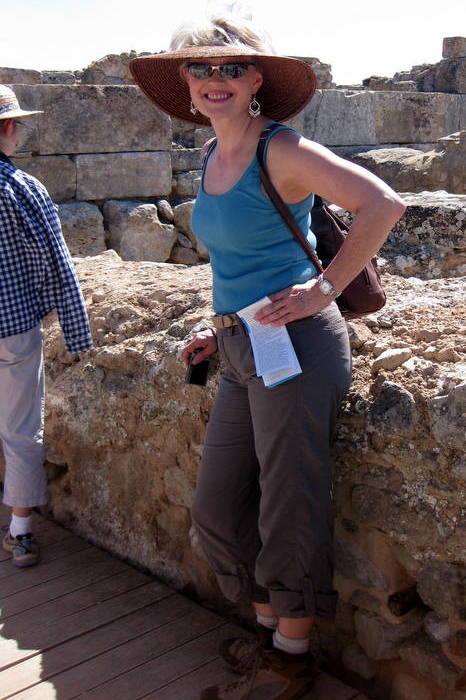
They therefore marched out into the countryside, the way the Barbizon School in France would concurrently do and the Impressionists later.  (The British Art World seemed to be completely unaware of what was happening in France or anywhere else that people painted.)  They went out and painted backgrounds en plein air, with all its attendant discomforts of wind, rain, insects, cold and heat; they built shelters, toted their equipment back and forth and wrestled with large canvases.  I really appreciate reading about this, because painting outdoors is very difficult and when you’re out there it often seems like it’s not worth it and you must be doing something wrong, because no one would ever have done this unless the whole project went more smoothly than this.

Here is a description of Millais painting the background for Ophelia:  He worked up the background of the stream and its bank dense with wildflowers and weeds, aware of the absurdity of struggling to render tragedy while swatting lies.  “My martyrdom is more trying than any I have experienced, “he wrote.  “The flies of Surrey are more muscular, and they have a still greater propensity for probing human flesh….Am also in danger of being blown by the wind into the water, and becoming intimate with the feelings of Ophelia when that lady sank to a muddy death….There are two swans who not a little add to my misery by persisting in watching me from the exact spot I wish to paint, occasionally destroying every water-weed within their reach.  My sudden perilous evolutions on the extreme bank, to persuade them to evacuate their position, have the effect of entirely deranging my temper, my picture, brushes, and palette….Certainly the painting of a picture under such circumstances would be a greater punishment to a murderer than hanging.”   Millais had more trouble putting a water rat into his picture than he did with the figure of Ophelia herself.  Water rats were hard to come by.  When his servant finally caught one, it began to decompose before Millais was able to render a likeness.  He had to call for a fresh corpse; the search was repeated, and before long he had run through three rats.  After all that, visitors came out from London complained that the rat shouldn’t be in the picture at all.  Some thought its proximity to Ophelia was indelicate; its presence obtruded on the viewer an awareness that a rodent would soon be feeding on the piteous virgin. (Probably the reason Millais even thought of putting it in; art should serve truth.)  Others simply couldn’t recognize the animal, guessing it to be a rabbit, a dog, a cat, anything at all but a rat.  So the artist painted the rat in and out, in and out, before finally concluding that it had to be banished forever.  In the end the rat triumphed:  Today any visitor to the Tate Gallery can see the distinct shadow of a fat, prowling rat in the upper right corner of the canvas. (GD)
I am personally certain that if the rat was still in the picture, it would look exactly like a rat.  Millais was a superb draftsman.  If he painted a rat; it was undeniably a rat.  I mean, look at this painting!  Could it be more believable.  I’d like to have his diary to know how long it took to paint that foliage.


Hunt was having his own animal difficulties.  His picture, The Hireling Shepherd, a parable about the shepherd who neglects his flock, was to feature more than forty sheep.  Hunt expected his sheep to be docile creatures.  Instead, nets, ropes, and a servant had to be employed to hold them in place.  When all else failed, Hunt directed his servant to pick up a flailing sheep and drop it to the ground, thereby rendering it insensible and cooperative. (GD)


These paintings were done after their first exhibition and after Ruskin had championed them.  The two friends sought a place they could go to work outdoors and encourage each other.  These paintings were done in Surrey from where they were settled at Worcester Park Farm.  Hunt used a local girl, Emma Watkins, as his model.  Lizzie Siddel was added in Millais London studio.  He was looking for an Ophelia, as I’ve looked for a Christina, a Phantom, or an Orpheus.

When Hunt and Millais painted Ophelia and the Hireling Shepherd, they’d already met Gabriel Rossetti and formed the Brotherhood.  That will be another Blog entry.  Just to show you what they were working on before Ophelia, which was a breakthrough painting for the whole brotherhood, drawing Ruskin’s support.  Here are the entries for their first exhibition:

The Flight of Madeline and Porphyro during the Drunkenness Attending the Revelry Eve of St Agnes, 1848, by William Holman Hunt.


For the first exhibition for which he submitted work beside Hunt, Millais was working on this one, Cymon and Iphigenia from Boccaccio’s Decameron, not to be confused with Iphigeneia of Greek Myth.   This is a story about a brutish sot, Cymon, who happens upon the sleeping Iphigenia and overcome by her beauty, is transformed by it.  He becomes an Italian Renaissance gentleman, with mental attainments as well as grace and manner.  When Iphigenia is engaged to marry another, he attempts to prevent it by abducting her, but is captured and imprisoned.  During the very wedding, he manages to escape and presenting himself at the wedding, fights the groom, kills him and marries her himself.  He and Iphigenia form a true love union.  Well, not to laugh, from this classical piece comes the plot of many a romance novel.

Hunt’s St Agnes was selected, Millais’ Cymon rejected.  This is perhaps the only Millais painting I don’t care for.  Well, maybe I don’t like Bubbles either.  Millais response was admirable.  Hunt wrote, “He was exceedingly brave about the disappointment, and – as was characteristic with him throughout life on encountering any check to success – he was very reticent on the subject, and now he hid the picture away.”   I do so like Millais.  He really was such a modest, hard-working and generous person.

Millais went to Oxford for the summer, getting away from the scene of his failure, but at the exhibition a fateful meeting took place.  An art student named Gabriel Charles Dante Rossetti went up to Hunt and declared loudly that The Eve of St Agnes was the best in the collection.  Although embarrassed by the volume of the praise, Rossetti’s compliment was very much appreciated.  Hunt wasn’t a man who’d been praised much, as yet, and though he doggedly believed in himself, intending to become the greatest religious artist of the age and was less likely to give up and lick his wounds than anyone on earth, one can imagine how this sparked a new and important friendship.

Next installment, Dante Gabriel  Rossetti  and the PRB, the truth about him and Lizzie Siddel.

Delaware Art Museum: Howard Pyle, John Sloan and Others

Juggling camera, backpack and a bag full of art cards!  Gorgeous spring day -- in the 60s -- in a lovely neighborhood, full of old houses.

Juggling camera, backpack and a bag full of art cards! Gorgeous spring day — in the 60s — in a lovely neighborhood, full of old houses.

Besides PreRaphaelites, the Delaware Museum was  hosting an exhibition of the great American illustrator, Howard Pyle, who taught N C Wyeth and a host of others.  I’d seen some of these paintings on a previous trip at the Brandywine River Museum, to whose permanent collection they belong.  However, there a great many I hadn’t seen, including wonderful ones rendered in black and white oils.  The draftsmanship is superb.  What a wonderful painter he was.  I’m so drawn to illustration that I surely would have tried to become a professional illustrator if it was still in the publishing budget of periodicals and regular fiction.  When I was growing up, I thought the ideal job would be to illustrate for National Geographic history articles.  Photography has taken the place of illustration in magazines and no pictures at all has become the norm in fiction. Our imaginations are the poorer for it.

….but I was able to revel in the wonderful illustrations I saw a the Delaware Museum for an entire afternoon.  Lucky me!

Before I get to Howard Pyle, I will post some of the non-PreRaphaelite works I saw.  Get ready:  there are a lot of pictures in this post!

Portrait of the Artist's Wife

Portrait of the Artist’s Wife


This was the most impressive painting I saw at the exhibit, and it’s not famous enough for me ever to have seen it before.  I’m sure the artist must have painted society portraits. This one is of his wife, who was an artist in her own right, an actress I think.  It’s large and I was looking up at it when close.  The texture and light of the fabric conveyed by the brushwork was amazing.  I don’t remember the artist’s name; I should have been carrying a notebook or taking pictures of all the signage.  You’d think I would have for this one.

Detail of drapery

Detail of drapery


Detail of hand and fan

Detail of hand and fan

Famous paintings generally reward the viewer, when they finally see the real thing and aren’t looking at an art book, with the conviction that they are deservedly beloved.  However, it’s my continual experience that the paintings by extremely skilled artists I’ve never heard of before are the ones that I’m blown away by at museums.  I’m often most affected by how a painter paints and what I like the most are paintings that convey a very convincing realism, but are not rendered in such a way that the brushstrokes disappear.  I LOVE oil paint.  I love to look at it.  Even when there are stunning sculptures or watercolors in the room, my attention will go immediately to the rich, glorious color and brushwork of oil paintings.  This one was so rewarding to look at.  Didn’t matter who the subject was.  The artist rendered her beautifully.  I wanted to grab handful of that skirt fabric; you could feel the weight of it just by looking!

South American Landscape by Frederic Edwin Church, 1873

South American Landscape by Frederic Edwin Church, 1873

I'm sorry that I have no notes about this one

I’m sorry that I have no notes about this one

This one was by someone I didn't expect, but little good it does me to remember that much about it, because I don't remember who it was.

This one was by someone I didn’t expect, but little good it does me to remember that much about it, because I don’t remember who it was.

I love the way this one is painted.  Can't tell you who it's by though.

I love the way this one is painted. Can’t tell you who it’s by though.

Early Autumn by George Inness, 1891

Early Autumn by George Inness, 1891

Throbbing Fountain, Night by John Sloan, 1908

Throbbing Fountain, Night by John Sloan, 1908

Jefferson Market by John Sloan, 1917, 1922

Jefferson Market by John Sloan, 1917, 1922

Wet Night, Washington Square by John Sloan, 1928

Wet Night, Washington Square by John Sloan, 1928

3-IMG_5570

The above is a wonderful plaster sculpture.  And now to Howard Pyle!

Who are we that Heaven should make of the old sea a fowling net? by Howard Pyle, 1909

Who are we that Heaven should make of the old sea a fowling net? by Howard Pyle, 1909

I think this is my favorite of all Howard Pyle’s illustrations — though that is a very hard thing to choose — because it is so romantic and the colors and costumes are so gorgeous.  I’d love to know what the story is about.  It reminds me of Daphne du Maurier’s Frenchman’s Creek.

Extorting Tribute by Howard Pyle from Fate of Treasure Town

Extorting Tribute by Howard Pyle from Fate of Treasure Town

The Mermaid by Howard Pyle, 1910

The Mermaid by Howard Pyle, 1910

So the Treasure was Divided by Howard Pyle, from the The Fate of Treasure Town, 1905

So the Treasure was Divided by Howard Pyle, from the The Fate of Treasure Town, 1905

Attack on a Galleon by Howard Pyle, 1905

Attack on a Galleon by Howard Pyle, 1905

The Dancer from "Lola" by Howard Pyle, 1909

The Dancer from “Lola” by Howard Pyle, 1909


The Flying Dutchman by Howard Pyle, 1900

The Flying Dutchman by Howard Pyle, 1900

The Buccaneer was a Picturesque Fellow by Howard Pyle, 1905

The Buccaneer was a Picturesque Fellow by Howard Pyle, 1905

I read at the Museum that Howard Pyle made up the original Pirate Costume.  He needed to illustrate Pirates, so he came up with a costume that was then adopted by Hollywood and a host of other illustrators.  This is so deeply impressed in our consciousness that we can’t imagine a pirate looking any other way, unless they are very refined pirates, like Captain Blood.

The Fight on Lexington Common, April 19, 1775 by Howard Pyle, 1897

The Fight on Lexington Common, April 19, 1775 by Howard Pyle, 1897

The Attack upon the Chew House by Howard Pyle, 1898

The Attack upon the Chew House by Howard Pyle, 1898

The Coming of Lancaster by Howard Pyle, 1908

The Coming of Lancaster by Howard Pyle, 1908

"A wolf had not been seen in Salem for thirty years" by Howard Pyle, 1909

“A wolf had not been seen in Salem for thirty years” by Howard Pyle, 1909


When the World Was Young by Howard Pyle, 1908

When the World Was Young by Howard Pyle, 1908

I quite like Pyle's illustrations that are black and white or very faintly colored as much as the ones in full color.

I quite like Pyle’s illustrations that are black and white or very faintly colored as much as the ones in full color.

Sorry that this one is a bit blurry, the fault of dim light and a wavering hand at the camera.

The Town Crier by Howard Pyle

The Town Crier by Howard Pyle

I actually don’t know the proper name for this one and, again, it’s a bit blurry, but I find these illustrations so rich and detailed to look at, like old photographs, but so much better.

Dick Turpin by Howard Pyle -- the hazy whiteness around the horsemen is me reflected in the glass

Dick Turpin by Howard Pyle — the hazy whiteness around the horsemen is me reflected in the glass.

This was exciting, but I don’t remember what the subject was. Looks like a sort of Alexander/Buchephalus affair.  The camera was very unfocused, I’m afraid.


05-IMG_5535

This was exciting.  Looks like a modern day Pegasus / Bellerophon affrair.

This was exciting. Looks like a modern day Pegasus / Bellerophon affrair.

Breton peasants in a storm

Breton peasants in a storm


Don't know what this one is about either

Don’t know what this one is about either.

Hey, but at least it’s not as blurry!

Besides Howard Pyle, there were a number of other illustrators.  I like the one below particularly.  It seems some callous wretch is about to abandon a woman in the mountains with her flat tire.  Cad!

"You can't leave here to suffer" by Gayle Hoskins, 1924 for Roads of Doubt

“You can’t leave here to suffer” by Gayle Hoskins, 1924 for Roads of Doubt

The Circus

The Circus

Hans Brinker, Frank E Schoonover, 1924

Hans Brinker, Frank E Schoonover, 1924

White Mayde of Avenel, Winifred Sandys, 1902

The PreRaphaelites go Hollywood

The PreRaphaelites go Hollywood

This is sort of awful, I think, but I totally get why they hung it.

4-IMG_5499

Boy and Flamingo by Frank E Schoonover, 1924

Boy and Flamingo by Frank E Schoonover, 1924

Now, what kind of adventure would a boy go on with a flamingo!  My mind’s a complete blank.  They look serious though.  Maybe a bird rescue mission.  Oh!  It’s from The Swiss Family Robinson!  I don’t recognize it, because I haven’t read it.  Misspent childhood.

Blackbeard in Smoke and Flame by Frank E Schoonover, 1922

This painting of a serenade was lovely.

This painting of a serenade was lovely.

By Frank Stick

By Frank Stick

The Springhouse by N C Wyeth, 1944

The Springhouse by N C Wyeth, 1944


Delaware Art Museum: PreRaphaelites

Waterfall, John Everett Millais, 1853

Waterfall, John Everett Millais, 1853

I just came back from visiting my long time friend, artist Julie Good-Kruger, Pennsylvania.  My most desired destination for this trip was the Delaware Art Museum, which I’d found out, since my last visit, has the largest collection of PreRaphaelite Art outside of Britain.  I brought my camera in and just kept snapping.  Most of these images are pretty good; some have a glare from the lights or had to be taken at an angle to avoid a glare, and some are simply a little blurry.  However, I think they’ll give a taste of why it is so worthwhile to visit this museum.

A Highland Lass by John Everett Millais

A Highland Lass by John Everett Millais

This painting shows Millais’ extraordinary sensitivity and accuracy in rendering his subjects, even when he was a very young man.


What was the PRB?

What was the PRB?

I’m back on a PRB kick right now and will write more at length about how they inspire me in another blog.  I’m currently rereading PreRaphaelites in Love by Gay Daly and The Legend of Elizabeth Siddal by Jan Marsh, as well as two mysteries inspired by Lizzie.

Portrait of Elizabeth Siddel by Dante Gabriel Rossetti, 1854

Portrait of Elizabeth Siddel by Dante Gabriel Rossetti, 1854

"They're what we call...stunners."

“They’re what we call…stunners.”


Veronica Veronese, Dante Gabriel Rossetti, 1872

Veronica Veronese, Dante Gabriel Rossetti, 1872

My favorite PreRaphaelites are John Millais and William Holman Hunt.  I saw a fabulous exhibit of Hunt’s paintings at the Minneapolis Art Institute a couple of years ago, when I was at an Equine Painting Workshop.  During my trip to PA, I spent one rainy day companionably working on art projects with Julie and her husband, Tim.  I was copying the painting below because it was raining and windy outside and my plein air plans were dashed.

Isabella and the Pot of Basil by William Holman Hunt, 1867-1868

Isabella and the Pot of Basil by William Holman Hunt, 1867-1868

Found, Dante Gabriel Rosetti, designed 1853; begun 1859

Found, Dante Gabriel Rosetti, designed 1853; begun 1859

This painting shows that Rossetti was at one time as taken up with social justice and narrative art as were Hunt and Millais.  Later, he just painted a select group of beautiful women over and over again.  I find the crusading spirit of the PRBs at their inception far more interesting.

The Council Chamber, Edward Burne-Jones, c. 1872-1892

The Council Chamber, Edward Burne-Jones, c. 1872-1892

Water Willow, Dante Gabriel Rosetti, 1871

Water Willow, Dante Gabriel Rossetti, 1871


Mnemosyne by Dante Gabriel Rossetti, 1875 -1881

Mnemosyne by Dante Gabriel Rossetti, 1875 -1881

1-IMG_5425

Gideon, glazed tiles by Harold Steward Rathbone, 1900

La Bella Mano by Dante Gabriel Rossetti, 1874-1875

La Bella Mano by Dante Gabriel Rossetti, 1874-1875


The Green Butterfly, Albert John Moore, c 1878-1881

The Green Butterfly, Albert John Moore, c 1878-1881

The Return of the Dove to the Ark by John Everett Millais, 1851

The Return of the Dove to the Ark by John Everett Millais, 1851

Detail from Love's Messenger, Marie Spartalli Stillman, c. 1885Detail from Love’s Messenger, Marie Spartalli Stillman, c. 1885

The Mother of Moses, Simeon Solomon, 1860

The Mother of Moses, Simeon Solomon, 1860

Simeon Solomon was Jewish and purposely selected models that looked Semitic for his subject.

Design for the cover of The Earthly Paradise by William Morris, 1890

Design for the cover of The Earthly Paradise by William Morris, 1890

The Earthly Paradise was a collection of verses that William Morris himself wrote — he was a poet, as well as painter and designer — about pagan Greeks and Scandinavians looking for everlasting life.  Odd bedfellows, I think.

The Somnambulist by John Everett Millais

The Somnambulist by John Everett Millais

The brushwork on this painting is looser than in others if Millais’ paintings.  He is apparently influenced by Whistler’s White Girl in this work.

May Margaret by Frederick Sandys, 1865-1866

May Margaret by Frederick Sandys, 1865-1866


Portrait of Ethel Bertha Harrison by Sir William Blake Richmond, c 1882

Portrait of Ethel Bertha Harrison by Sir William Blake Richmond, c 1882

1-IMG_54722-IMG_54261-IMG_5466

Saint Columba's Farewell to the White Horse by Alyce Boyd

Saint Columba’s Farewell to the White Horse by Alyce Boyd

Detail of Spring and Autumn by Lydia Field Emmet, Delaware Art Museum

Detail of Spring and Autumn by Lydia Field Emmet, Delaware Art Museum

The Spring Witch by George Wilson, 1880

The Spring Witch by George Wilson, 1880

Design for a Stained Glass Window by Violet Oakley

Design for a Stained Glass Window by Violet Oakley

Julie and I just adored this design and just looked and looked.  It’s actually a painting.  The windows that resulted were installed in a manor, but I had only a camera with me, not a notebook.

1-IMG_5561

Amazing British Watercolor

Amazing British Watercolor

This is truly the softest toilet paper we sell!

This is truly the softest toilet paper we sell!

We were snorting with laughter at this painting.  It’s quite lovely, really, but I mean, what can he be showing her?