A Taste of the St Louis Art Museum

I’ve just come back from five days in Saint Louis, MO with my daughter, Iphigeneia, and friends, Anna and Sue.  I tried to take photographs of paintings I particularly liked in the Saint Louis Art Museum, which I will post here, but with the warning that some are slightly distorted and  cropped, due to the angle from which I could view the painting and sometimes a little blurry due to the lighting available.  Hopefully you will get a taste of the art available to see in Museums in Saint Louis.

Nona, Geneia, Sue and Anna in front of the St Louis Art Museum

bronze sculpture of Saint Louis

The Apotheosis of Saint Louis

Saint Louis a.k.a. Louis II of France, a crusading French King from the 13th Century, is the symbol of the city.


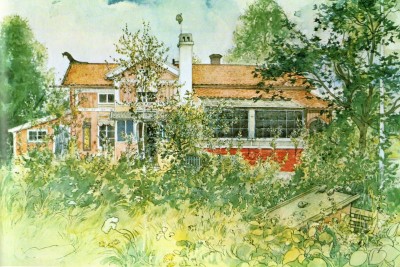
Old Homestead in Connecticutt by Willard Leroy Metcalf

This is my personal favorite painting in the Museum.  It depicts a New England house on a moonlit night and is so charming, I instantly wanted to step into the scene and enjoy the music of crickets and the evening breeze, then join the cozy party indoors.  Notice the lit window on the side of the house.
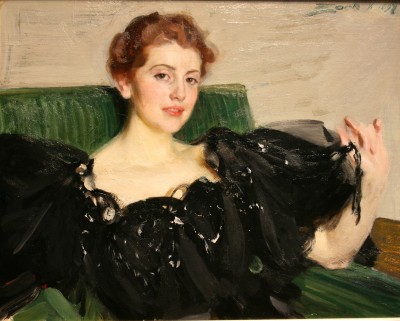
oil painting by Anders Zorn

A Portrait by Anders Zorn

Anders Zorn is a 19th Century Swedish painter who is widely admired for his loose, elegant brushwork and glowing colors, very like John Singer Sargent.

oil painting of a river landscape, Daubigny

The Banks of the River Oise by Charles-Francois Daubigny

Daubigny is my favorite painter of the Barbizon School.  He often painted landscapes at dusk and is particularly admired for his river scenes.  The first Daubigny I ever saw was at the Cincinatti Art Museum:  One half of the painting was of a shadowed hillside just before sunset.  There are cows lying in grass in the shade.  The last rays of sunlight are illuminating the opposite side of the painting, where one can see a greater distance.  It was that point in the day where one can still see with great clarity everything around you, but wouldn’t be able to photograph it.  The shadows would end up too deep and the sunlit areas too bleached.  At that time of day everything appears to have its own inner luminosity, but it will vanish in a quarter of an hour.  Daubigny was brilliant at depicting that light.  He was out there with his canvas capturing it and memorizing it.  My photograph of the painting of the Oise above does not do it justice.  One must see Daubigny’s paintings to appreciate how good they are.


Inness landscape

Medway, Massachusetts by George Inness

An American painter who evoked the atmospheric beauty of landscape was George Inness, who studied in France and was won over by the Barbizon vision.  As can be seen in the painting above, Inness’ interest was in the emotions that landscape and being outdoors can evoke, and saw it as a means to cultivate spiritual appreciation.  “The poetic quality is not obtained by eschewing any truths of fact or of Nature…Poetry is the vision of reality.”
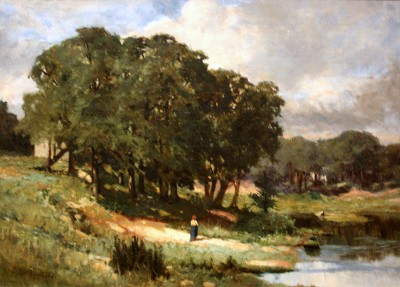
oil landscape by Edward Mitchell Bannister

Woman Standing Near a Pond by Edward Mitchell Bannister

While going through the Saint Louis Art Museum, I noted three paintings that were described as being painted by an African-American.  (If the artist’s race had not been mentioned in the write-up, I wouldn’t have known.)   It was interesting and impressive, because of the time period in which they lived and worked.  Bannister lived from 1828 to 1901.  As often happens in the art world, though Bannister was successful and well known in his day, he was largely forgotten.  The Civil Rights Movement of the 1970s brought attention to his work once more and it began to be celebrated and collected again.  As can be seen in the painting above, Bannister’s work deserves the attention.

oil portrait by Renoir

Geneia particularly liked this portrait by Renoir

studio scene by William Merritt Chase

The Tenth Street Studio by William Merritt Chase
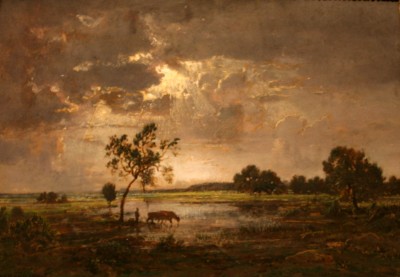
landscape oil by Theodore Rousseau

A Pond Near the Road by Theodore Rousseau
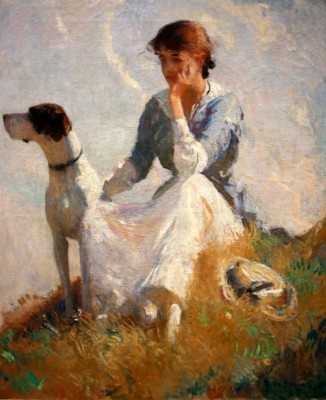
oil painting of girl on hill with dog

A contemplative painting by Frank Benson

Renoiresque portrait -- I'm afraid I don't remember by whom
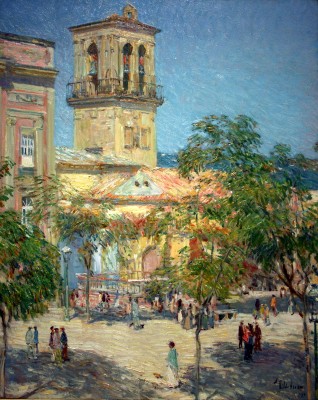
Spanish street scene by Childe Hassam

Street of the Great Captain at Cordoba by Childe Hassam
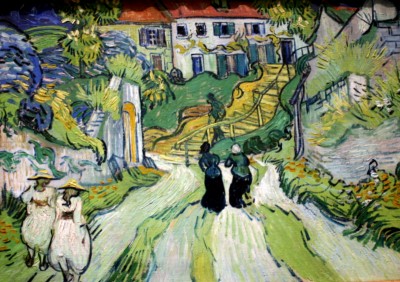
Van Gogh landscape of two women walking

Stairway at Auvers by Vincent Van Gogh

oil painting of a middle eastern arched gate

An Orientalist Painting in the Impressionistic Styte

Unfortunately, I don’t remember who painted this.  I have always found Orientalist paintings colorful and interesting.  I especially like the paintings of Jean-Leon Gerome.  This one was unusual, because it was painted by an impressionist.  I’m afraid I only carried my camera through the museum, not a note-pad, and I don’t remember the artist.
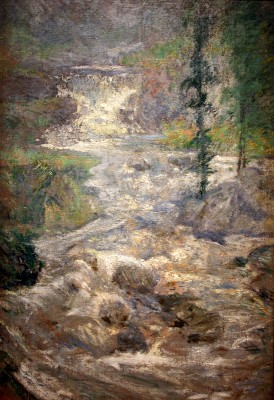
impressionistic oil painting of a waterfall

Landscape by John Henry Twachtman

One of the things that was pointed out about Twachtman’s work was the “shimmering effect” he created with broken color.  This painting really does have the shimmering effect that water vapor and sunlight might create.  When viewed closely, the paint is very layered and broken.

American Impressionist Painting

I don’t remember the artist, but one of the amusing things about things about this artist, is that when the Impressionists first exhibited in France, this American artist regarded their paintings with “horror.”  Twenty years later he was painting just like them.  Our senses are educated in beauty by familiarity.
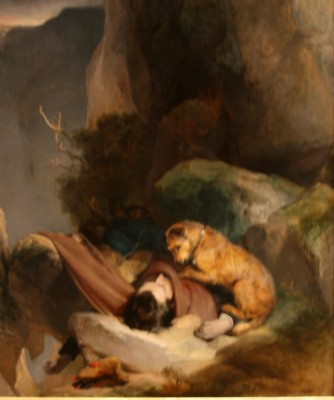
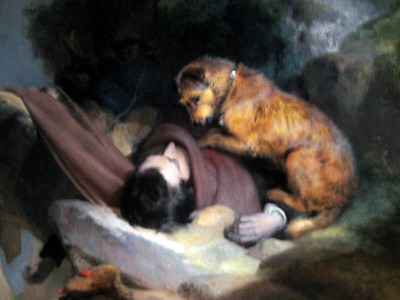
oil painting of a faithful dog

Attachment by Sir Edwin Henry Landseer

Too bad it’s a little blurry.

Arab Horseman a la Delacroix

Arab Horsemen a la Delacroix

I don’t remember who painted this, but I liked it.  There was a Delacroix painting too, with its characteristic, violent postures and action.  Here is that one.  It’s a little blurry.

Oil painting of a capture by Eugene Delacroix

Weislingen Captured by Gotz's Men by Eugene Delacroix

A better image may be viewed by clicking here.

Bridge in New York State

Three Women in a Studio by Max Beckmann

This was the most domestically pleasing of the many Max Beckmann paintings at the St Louis Art Museum.   The description beside it included this note:  “As with many of Beckmann’s early works, the painting is inscribed HBSL in the upper right, an abbreviation for Herr Beckmann Seiner Liebsten (Mister Beckmann to his love), a dedication to his first wife, Minna.”

Titanic sinking oil painting

The Sinking of the Titanic by Max Beckmann

For a better image, click here.

arresting assylum patients after earthquake in Messina by Max Beckmann

Scene from the Destruction of Messina by Max Beckmann

This painting depicted insanity patients being apprehended after a great earthquake in Messina in 1909.  For a better image, click here.
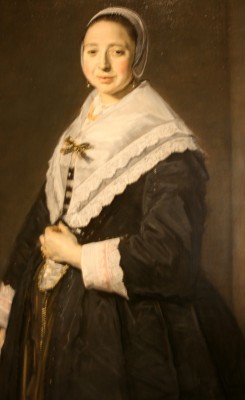
oil painting of a woman by Frans Hals

Portrait of a Woman by Frans Hals

pastoral court scene, French Eighteenth Century

Repose in a Park by Jean-Baptiste Joseph Pater
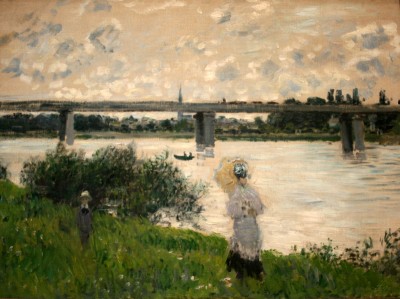
impressionistic Monet painting of a river scene

The Promenade with the Railroad Bridge, Argenteuil by Claude Monet

Native American Horse Thieves portrayed by French Artist

Native American Horse Thieves portrayed a a French Artist

Presumably these are plains Indians.  Note that one of them is wearing a leopard or jaguar skin.  The French had a very romantic view of American natives ever since James Fennimore Cooper wrote and published the Leatherstocking Tales in France.

dutch skating painting

Skating Near a Town by Henryk Avercamp

painting of a French prostitute by Lovis Corinth

Nana, Female Nude by Lovis Corinth


painting on lapis stone

Perseus Rescuing Andromeda by Cavaliere D'Arpino

This lovely Perseus and Andromeda is painted on lapis lazuli.  That’s what the deep blue is.
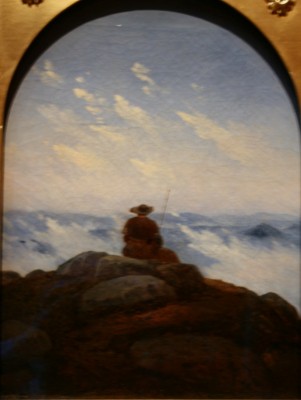
German landscape, Eighteenth Century

Wanderer on a Mountaintop by Carl Gustav Carus

Carl Gustav Carus was a friend of Goethe and a renaissance man.  In 1811 he graduated as a doctor of medicine and a doctor of philosophy. In 1814 he was appointed professor of obstetrics and director of the maternity clinic at the teaching institution for medicine and surgery in Dresden.  He wrote about art, psychology, especially that there is an antagonistic unconsicous poised against our conscious selves, and physicology, developing the theory of the vertebrate archetype.He learned landscape painting from Caspar David Friedrich, whose work the painting above strongly resembles.

oil portriat of Vigee Le Brun's brother

Portrait of the Artist's Brother by Louise Elizabeth Vigee Le Brun

Louise Elizabeth Vigee Le Brun was an Eighteenth Century artist who painted many portraits of the French nobility, including Marie Antoinette.  Her work was critically acclaimed in her lifetime.  She was able to combine marriage, motherhood and a career in art, a fact that is commented on persuasively to Marie Grosholtz  in Madame Tussaud, a new novel about the French Revolution.  Marie Grosholtz was the maiden name of the famous and equally accomplished wax portraitist who later became Madame Tussaud.  She lived, worked and survived the events of the French Revolution.  I highly recommend this novel.  Vigee Le Brun painted this portrait of her brother when she was only eighteen.

oil landscape by Henri-Joseph Harpignies

The Village Church by Henri-Joseph Harpignies

Another of the Barbizon School of painters, Henri-Joseph Harpignies painted this distant church in the Allier region of central France.
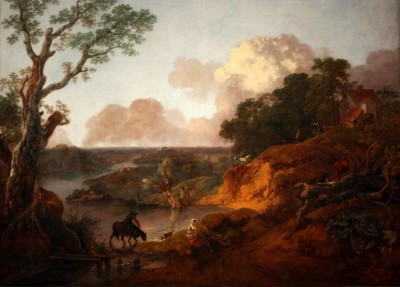
Oil Painting of Sussex Scene by Thomas Gainsborough

View in Sussex by Thomas Gainsborough

Still life by Jean-Simeon Chardin

The Silver Goblet by Jean-Simeon Chardin


Calvary -- I don't know by whom

Miniature in St Louis Art Museum

 Amazing Miniature

faithful dog with fallen master by Edwin Henry Landseer

Detail from Attachment by Sir Edwin Henry Landseer (Anna got a clearer picture than I did.)
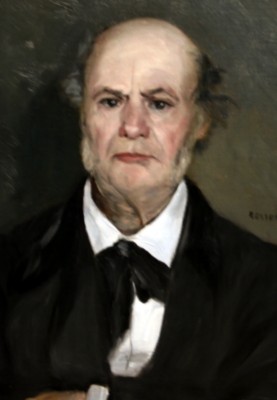
artist's father

This portrait is of some unfortunate painter’s father — I don’t remember which one — but he didn’t want his son to be an artist.  It’s pretty apparent in his face, don’t you think?  He didn’t think much of modeling for a portrait either, I take it.
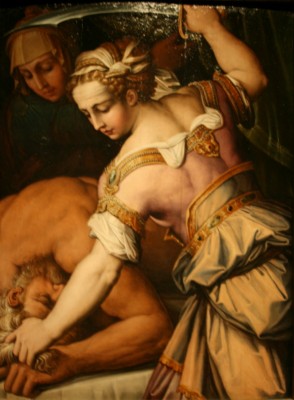
oil painting of Judith and Holofernes

Judith and Holofernes

 The delicate mauve shading under the yoke she wears over her shoulders is supposed to indicate that she’s wearing a dress.  It doen’t read like that to me, but the artist didn’t want to distract from her musculature to make the fabric more apparent.  He meant her obvious physical strength to portray her strength of purpose as she kills the Assyrian invader.
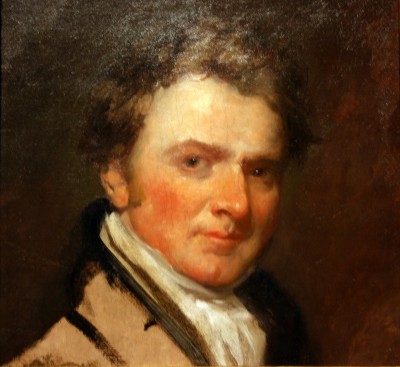
oil portrait by Gilbert Stuart

Portrait of a Gentleman by Gilbert Stuart

flamenco dancer by Robert Henri

Betalo Rubino, Dramatic Dancer by Robert Henri

French painter's interpretation of Native American Horse Thieves

Horse Thieves

This romantic interpretation of American Indians by a French artist has one of the horse thieves wearing a leopard or jaguar skin.  It adds an exotic element.  The French became enthralled with the American frontier when James Fennimore Cooper wrote his Leatherstocking Tales in Paris.
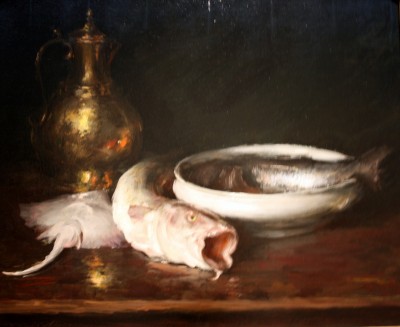
oil painting of a fish by William Merritt Chase

Still Life by William Merritt Chase

The Country School by Winslow Homer

Me below the statue of St Louis

Hope you enjoyed your abbreviated tour of the St Louis Art Museum.   There were a number of paintings that were not currently on view — I know this from perusing the St Louis Art Museum Website — so I’ll have to get back there someday.  I had thought to visit Kansas City, MO on this trip too, but it turned out to be impractical.  Another day, another art trip!


The Revolution they had in mind….

Arts and Crafts room England

Entrance Hall Alcove Sitting Room, Wightwick Manor

Have nothing in your houses which you do not know to be useful or believe to be beautiful.  William Morris

I’ve been writing about the Arts and Crafts movement in Sweden, Finland and Great Britain, and I just found a wonderful synopsis of the philosophy by Stephen Calloway in the book, The Arts and Crafts Houses in Britain:

The great protagonists of the Arts and Crafts cause were in a real sense revolutionaries.  The artists, craftsmen, thinkers  and writers, architects and designers who initiated the movement in the second half of the nineteenth century and those who carried it forth into the twentieth shared an ideal of changing the world….That this revolution was to be entirely peaceful one does not mean that it’s aim was any less radical.  But this would be an uprising of makers, not destroyers; of artists and aesthetes, not iconoclasts.  These high-minded revolutionaries had no wish to pull down governments of rdepose kings.  They sought, however, nothing less than the overthrow of what they perceived to be an iniquitous social order, a system founded upon the exploitation and degradation of labour; a system based upon greed that filled the marketplace with shoddy goods and a commercial world that found the inevitable expression of its debased values in the ever-increasing ugliness of modern life. 

The desire of these revolutionaries was to bring about a new artistic and social order not by forcing change and innovation upon an uwilling public but, rather, by showing that there is a better way to live.  This improvement would be achieved, they believed, in large part, by a return to the old ways.  Their goal was to re-create a world in which beauty could again triumph over meanness, ugliness and utilitarian compromise.  By championing the old craft skills against the power of the machine, they aimed at the reversal of the inexorable and overwhelming trend of nineteenth-centruy “progress” towards the production of almost all everyday goods in soulless factory conditions.  The men and women of the Arts and Crafts movement sought, above all, to transform manufacture and thereby to change society, bringing content and delight to the rich man and the poor alike through the making of beautiful things.  In the joys of fine craftsmanship lay the answer to the besetting miseries of the age; all would achieve happiness, either as the reward of honest work or through living well in the possession of Beauty.

The quintessential expression of these lofty, but, as they fervently believed, universally applicable ideas lay in the creation of the “House Beautiful.”  Not surprisingly, this was an ideal most readily achievable by the rich, but it remained a concept that, at its most utopian, aimed at the improvement of not only the mansion of the wealthy p0atron but also the simple dwelling of the working man. 

The idea of a house fashioned, for those who could afford it, from top to bottom according to the vision and design of a single artist or architect waqs, of course, nothing new; in the early eighteenth century William Kent had been celebrated for the care that he bestowed upon devising the entire look of his projects, specifying everything from the the plan of the house and its every architectural flourish down to the shape of the chair or table, the fall of a drapery and the moulding of a picture frame.  Adam, Wyatt, Soane and other architects of the late eighteenth and early nineteenth centuries had revealed a similar genius for dictating the interior decoration, choosing colours and fabrics and designing the furniture for their houses.  But such architects held themselves aloof from their craftsmen and tradesmen, expecting them to follow design drawings and the written specifications of works to the letter…..

William Morris, the founding father of the Arts and Crafts and the tireless powerhouse of the erly days of the movement, was the first to approach the whole question of design and manufacture in a new way….Having fallen under the infulence of the Pre-Raphaelite poet-painter Dante Gabriedl Rossetti, and already in love with the literature and legend of the Middle Ages, Morris made the great intellectual leap of seeing in the art, the buildings and the craftsmanship of that distant era a viable model for reforming the ills of modern industrial society. 

To Morris and to other thinkers, such as John Ruskin, the impoverishment of the visual and material culture of the day appeared as the damning indictment of both the gross social inequalities and the creeping banality and imaginative impoverishment of the modern world.  The great answer, as Morris would argue over a period of forty years of ceaseless activity, lay in reversing the century’s headlong rush towards urbanisation, captialist trade, factory production and the division of labour, in favour of a return to ancient traditions of both work and social orgainisation.  The reform and salvation of the nineteenth century was. he suggested, to be achieved only by a return to the wholesome ideals of an earlier age.  Morris urged in particular the adoption of the ethos of the medieval guildsmen and master craftsmen.  These were men, Morris believed, who had pride in their skills and knew the value of fine materials.  They were, crucially, designer-makers who understood every process of their trade and took delight in the making of beautiful objects, simple in structure and adorned with meaningful ornament.  Working in this way, Morris hoped, workmen would once again be their own masters, employed by enlightened and honourable patrons; how could such men fail to take pride in their work and live fulfilling lives?

Morris and the others of his ilk didn’t manage to revolutionsize the values of their fellowmen, but they did manage to create houses, paintings, furniture, wallpaper, books and other items that were worth preserving and loving.  That is their legacy and I don’t think any artist can hope for more.

When I read this description of the Arts and Crafts inspiration, I identify it as an indictment of the American predilection for immediate profit, rather than even an intelligent evaluation of beauty ( since communities that preserve their better architecture attract more people than those that don’t),  the wisdom that knocks down homes of archtitectural significance in order to put up a fast-food shop or drug store, as has been done in my memory in Verona and Platteville.  Mineral Point remains a sort of oasis and I hope it goes on that way.  In the meantime, my spirit is with those Arts and Craftsmen, who worked at making beautiful things and hoped to inspire their fellowmen to do the same.

My New Kitchen

hand painted wall

My Hearth at Rosewind Cottage

I designed the painting around the hearth by taping tracing paper to the wall and just drawing to fill the space.  Then I would add on another and continue the design.  The swirls and scrolls grew, page by page.  I would tape the pages together, then flip them and do the other side of the center.

Tracing design onto wall

Hearth Design in Progress

Hand painting on wall

Painting around my hearth

Pug on footstool

A friend decides to keep me company

The painting hanging to the right of the fireplace is Auction by Ken Stark.  My late husband, Matt, bought it for me as a surprise, because I admired Stark’s paintings so much in a exhibit at Story Pottery in Mineral Point a few years back.

oil painting of an Amish auction

Auction by Ken Stark

decoratie painting around plate rack

My Plate Rack, Rosewind Cottage

oil painting of Scandinavian kitchen at breakfast

Breakfast in my new kitchen

I couldn’t wait to bring this painting home from the Iowa County Courthouse, so I could hang it in my new kitchen.  I rhapsodized to my daughter, “Doesn’t it look good in this room?”  She replied, “That’s because it is this room, Mom.”

Carl and Karin Larsson: Their Collaboration, their Critics and their Transcendency

Last week I began re-perusing a book I’ve owned for some time called The World of Carl Larsson.  As I’d mentioned, I’d been drawn for years to the paintings Larsson did of his home and like many another person of Scandinavian origin, wanted to create a similar atmosphere in my own.  I had read that Larsson’s books, illustrated by his paintings, had revolutionized home decorating in his own day.  I can well believe it.  His home was filled with light:

Carl Larsson interior

The Flower Window

I’ve been reading about Carl and Karin out of interest, because they were both artists, wanting to know more about their collaboration.  Hans-Curt Koster writes (The World of Carl Larsson), “Karin no longer manifested herself artisitcally with her own artwork after 1884, the year Suzanne was born, so far as we know.  Her achievements in the field of textile art, which are to be seen mostly in Carl’s pictures from their home setting, stem almost all from after 1897.  But art historians are agreed that the creation of the Sundborn home, was chiefly if not practically exclusively the work of Karin, though Carl did have a hand in it.  It is also the prevailing opinion that Carl profited from Karin’s feel for color-effect.”

So, the Larsson home should more aptly be called the Karin Larsson Home.  As I have already mentioned, Carl and Karin met at a Swedish artists’ colony outside of Paris in the 1880s.  They were both painters.

I have learned by reading exerpts of The World…, that after he became Sweden’s most beloved artist, Carl was attacked and deeply hurt by critics in his later years.  This is not an unusual experience for anyone who achieves fame and becomes a role model.  The critic that probably packed the worst sting was a former champion of his, August Strindberg.  Strindberg had asserted in A Blue Book (1908), that “Carl and Karin Larsson, who at the time were the most celebrated family in Sweden, were merely putting on a show the whole time, were not revealing their true characters because the latter were diabolical and despicable, and especially that the Larsson domestic bliss, well-known throughout the kingdom, did not in reality exist — was just a lie.” (Strindberg’s assertion paraphrased byHans-Curt Koster)  A more recent critic, chiming in with Strindberg, alleges that “Carl and Karin were united only by hate-love and desire for notoriety.  Because Carl ‘forbade’ his wife to continue her work as an artist, she took revenge on him by forcing Carl to paint only what she had thought up.”  This latter is to comment on whether the Larsson paintings of their home and family life were the creations of them both or of Carl only.

Well, as Koster admits, it’s impossible to answer such critics definitively, since the Larssons, Strindberg and the whole pre-world war era is irrevocably gone, but it strikes me as highly unlikely that the two existed in a love-hate, ambition-driven dependency.

The fact that Carl Larsson had made his personal life the subject of his paintings, thereby creating an idyll, was undoubtedly due to the fact that the books, illustrated by his artwork, were well-received and liked.   We are the beneficiaries of his idyll.  But even after the public taste in art changed and Larsson became for many a paradigm of bourgeois complacency, at best irrelevant as a contemporary artist, and at worst, a hypocrite, he continued to paint happy pictures of his home life.

I see Larsson as faithful to his vision.  He wrote, “For life is, indeed, dreadful.  Each one makes the best he can of it but if one of us sometimes has something so bearable, yes, happy,…he can not help seeing side-by-side with himself…angry..individuals….One beast torments and devours the other, one flower stifles and kills the other…For many years you have been happy to call you best friend your own and then he turns his face against you — that is hellish….That is life….But we must, in order not to despair, keep saying encouraging things to ourselves and saying: “Nice weather we’re having today!

Larsson consciously made himself the the apostle of domestic happiness.  He had had the opposite experience of childhood and family himself.  His father had abandoned the family to poverty and struggle in a slum, surrounded by every kind of vice and evil.  That was Carl’s memory of it.  He, on the other hand, having married the right woman — and who can contest that marrying a person who will build you up, rather than tear you down, is one of the foundations of a successful life — was determined to create something else.  Koster writes that in the moment of Carl’s and Karin’s falling in love, they had been painting together.  Carl had experienced a revelation, in his words:  “And then we both painted Mere Morot.  And the scales fell from my eyes!  I had up to now not brought my so called talent into any kind of form, but now I had immediately succeeded with a little masterpiece, I think, because I got a medal for that picture.”  Koster goes on, “The moment when the ‘scales fell from his eyes’ had been for Carl Larsson definitely the most important thing in his life as an artist.  This moment could have been of equally great importance for Karin, who together with him had painted Mere Morot.  She wrote later to her parents that she had never felt so safe, so calm and so strong at the same time so devoted as now.”  Koster concludes, “This shared creative intoxication was probably sought again and again by the two, and in my opinion it is only natural if Carl and Karin shared in creating the subsequent Larsson pictures.”

I will not comment on the facts of nature, that women bear children and men don’t, which has been forever the reason women’s talents have rarely had the opportunity to be honed to the degree men’s have.  This was no doubt at work in Carl and Karin’s relationship.  However, I do not find it hard at all to believe in relative domestic bliss.  Way back in 1994, when the movie version of Little Women, starring Winona Ryder and Christian Bale, was released, having a chance conversation with someone in a doctor’s waiting room.  The (younger) woman told me she “despised the movie, because no one’s life was so sweet and cloying.”  My response was only, “Ummmmmm…..”  Frankly, such a wholesome family experience was completely famiiar to me, probably more banal and less story-worthy, but when I looked about myself, at my own life and that of my friends’, I didn’t find Little Women particularly unrealistic.  (Louisa May Alcott had really wanted to write thrillers and gothic novels about murder and romance, not a novel extolling virtue and personal growth.)  It’s certainly an edited version of Victorian life, but I think the spirit that pervades it is a completely valid human idealism.

Human idealism, a penchant for turning to the wholesome and upbuilding, is as valid as anything darker.  It is a real part of the spectrum of human experience, especially if one is determined to choose it over despair and bitterness.

Going to play cards

Just a Sip?

I’ve had this print hanging in my kitchen for years.  It shows the Larssons preparing for a card party and guests.


children's theatrics

Lisbeth Playing the Wicked Princess

family picnic

The Crayfish Season Opens

We had just such family picnics at Rabbit Lake (Aitkin, MN) on Midsummers’ Day when I was a child.

alfresco lunch

Breakfast under the Big Birch

My grandmother had a special fondness for a large birch at their family farm in Lappajarvi, Finland.  She came from a family of many sisters and brothers.  This painting has always reminded me of her childhood.

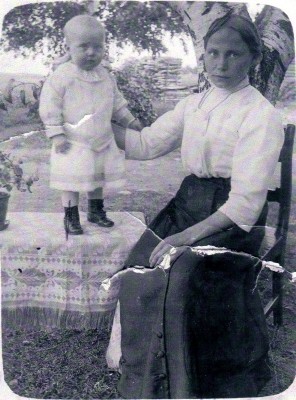
My Grandmother and Uncle Unto under the Big Birch

I know this photo needs photoshopping badly, but I don’t happen to have Photoshop right now.

Swedish Cottage

Carl and Karin's Cottage


Who wouldn’t want to stay here?


Home Decoration

Carl Larsson's home
Carl Larsson’s home decoration

One of my influences is the much loved Swedish artist, Carl Larsson.  He had much in common with other artists of his time who wanted to develop the unique national character of his homeland through his paintings and his home decoration, but he had that added advantage of marrying another artist, Karin Bergoo.  Karin was educated at the Arts and Crafts School in Stockholm and went on to study at the Art Academy there.  She met Larsson at an artist’s colony in France, outside Paris.   (The protean William Morris of England is another of those who spring to mind  as endeavoring to bring their sense of beauty and utility to bear on every aspect of their life, including home and business.  His wife became the muse and model of Dante Gabriel Rosetti and is probably the most famous “face” of the PreRaphaelite movement.)

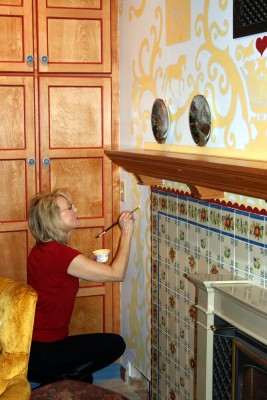
In their wake, I continue to decorate my home.  I’m currently redecorating my kitchen.  When we built the home in 1991, I painted and fired the tiles that surround our zero-clearance wood-burning stove.  Later I painted more to create a backsplash beneath our cupboards.  Much later, I painted Gothic Arches around my living room and foyer to evoke the English cottages I so love.  Last week and this, I have been painting scrollwork around my kitchen.  The walls had been a sponged parchment color.  Now, it is pale blue (with a violet cast) and I have been painting a bright yellow scroll of my own design.

hand painted decoration

Kitchen Scrollwork

I sort of create the designs as I go, judging what is needed.  It is, of course,  much easier  to judge whether something is pleasing or not once it’s been done, but fortunately I’ve liked everything so far.  The plate rack is my favorite “moment” in the kitchen so far.

decorativewall painting

The surround for my plate rack

From here I go on to design scrollwork for my fireplace.  Here’s how it looks currently:

Mantel decoration in progbress

The Mantel, waiting to be decorated


painted wall decoration

Rose design

Now I have to design some scrollwork to surround the fireplace.

hand drawn design

Designing at the Kitchen Table

I haven’t settled on anything yet.  It is a work in progress!


LOL

Detail on Artemis

Bowstring

This painting was in the Longbranch Gallery for 2 1/2 months before someone noticed that I’d forgot to string the bow!  I can’t believe it didn’t occur to me.  Oh well, it’s strung now!


Never better, mad as a hatter,

right as rain, might and main,

hanky panky, hot toddy,

hoity-toity, cold shoulder,

bowled over, rollin clover,

low blow, no soap, hope

against hope, pay the piper,

liar liar pants on fire,

high and dry, shoo-fly pie,

fiddle-faddle, fit as a fiddle,

sultan of swat, muskrat

ramble, fat and sassy,

flimflam, happy as a clamj,

cat’s pajamas, bee’s knees,

peas in a pod, pleased as punch,

pretty as a picture, nothing much,

lift the latch, double Dutch

helter-skelter, hurdy-gurdy,

early-bird, feathered friend,

dumb cluck, buck up,

shilly-shally, willy-nilly,

roly-poly, holy moly,

loose lips sink ships,

spitting image, nip in the air,

hale and hearty, part and parcel,

upsy-daisy, lazy days,

maybe baby, up to snuff,

flibertigibbet, honky-tonk,

spic and span, handyman,

cool as a cucumber, blue moon,

high as a kite, night and noon,

love me or leave me, seventh heaven,

up and about, over and out.

Sharon Bryan

Sweater Weather:

A Lovc Song to Language

Breakfast

Breakfast Border Painting

Breakfast

I don’t even want to think about how much time I spent on the border all told.  It’s enough that I always enjoy a border, once it’s there.  I will probably continue to do them, at whatever sacrifice of time.  It’s hanging now in a show at the Iowa County Courthouse in Dodgeville, 2nd floor.

(Update:  I donated this painting to the Nursing Home where my mother died in October of 2014.)


What I Read in 2011

Prefatory Statement:   I’m on a quest to own all of Dick Francis’ novels on audio CD, so that’s why you will see so many of them reread this year.  I’d rather listen to Tony Britton or Simon Prebble than anyone else on earth.  I have read all these novels before, some of them at least twice before, but I’m listening as I’m painting and Dick Francis always bears listening to again.

Detail from Hazelnut Torte with Beverly of Graustark


Cleopatra, a Life by Stacy Schiff — an excellent biography, eschewing the stereotype of Cleopatra as a vamp and emphasizing her political shrewdness and determination, not to mention the ruthlessness that characterized all the Macedonian rulers of the Hellenistic Age.

Proof by Dick Francis — In our family Dick Francis novels are reread many times as tried and true entertainment

Flying Finish by Dick Francis — possibly the most exciting ending of all his books

The Beacon at Alexandria by Gillian Bradshaw — at least my fourth reread, the perfect historical novel

Major Pettigrew’s Last Stand by Helen Simonson — I loved this book!  I loved everything about it: it’s Britishness, it’s humor, it’s decency, it’s funniness!  Highly reommended!

The Sun’s Bride by Gillian Bradshaw — a newer (and shorter)  novel of Bradshaw’s about piracy (seagoing) and the arts in the Hellenistic world.  As usual, I was rooting for Bradshaw’s characters and enjoying historical fiction that is entirely palatable, not full of gratuitous violence or a bleak estimation of human nature.

I Think I Love You by Allison Pearson — by the author if I Don’t Know How She Does It, recently made into a movie, this one was equally good; about a girl who wins a contest to meet David Cassidy, but doesn’t find out for 24 years.  As in the first novel, the reader is privy to virtually all the character’s thoughts and feelings, and the plot sort of grows out of it.  I enjoyed it.

1434 by Gavin Menzies — how the Chinese jumpstarted the Italian Renaissance; very eye-opening and completely fascinating!

The Paris Wife by Paula McLain — biographical novel about Ernest Hemingway’s first marriage and their life among the literati in France and the Riviera; paints a very good portrait.  I completely enjoyed it.

Churchill by Paul Johnson — short biography of Winston; his 2nd WW leadership was moving and inspiring.  Winston Churchill painted when he was defeated and depressed, because “you can’t think of anything else when you’re painting.”  I agree that painting is the best remedy for despair.  You really can’t do both at the same time, unless your painting actually generates despair, which it sometimes can.

I Remember Nothing by Nora Ephron — fun, light reading

Lost in Shangri La by Mitchell Zuckoff — true life adventure story about being stranded among head-hunting aborigines in New Guinea.  Great reading!

Out of Character:  Surpising Truths about the Liar, Cheat, Sinner (and Saint) Lurking in All of Us by David DeSteno and Piercarlo Valdesolo — interesting discussion of psychological tests that demonstrate how human nature really works.  The explanation of conscience by evolution sounds fantastical to me though, and I would have preferred not to be bothered with such unconvincing discursions.

An American Heiress by Daisy Goodwin — good read; Portrait of a Lady with a happy ending; doesn’t have the literary elegance or penetration of Henry James or Edith Wharton, but it’s a quality novel.

A Brief History of Anxiety by Patricia Pearson — a very well-written personal memoir, with critical reflections on how anxiety disorders are treated in the US.   I recommend it.

Her Royal Spyness, A Royal Pain, Royal Blood,  and Naughty in Nice by Rhyss Bowen — Geneia and I enjoyed these light mysteries about a destitute, but plucky royal — 32nd from the throne — during the 1930s.

Second Wind by Dick Francis — our favorite travel author; I’ve only read this one once before, so I wasn’t able to quote it verbatim

Trial Run by Dick Francis

Conquistador by Buddy Levy — very good history of the conquest of Mexico by Hernan Cortez.  The narrator was criticized on audible.com for sounding like the Frito Bandito when speaking for Cortez, and I had to admit he did a bit.  I think he was doing “tough soldier” and that just happened to sound like “you know who,” but the narrator does an excellent job of pronouning all the Aztec names and of not losing the listener.  I highly recommend it.

Break In and Bolt by Dick Francis — among my favorites.  I love the relationship between steeplechase jockey, Kit Fielding, and Princess Cassilia, for whom he rides.

Something Borrowed by Emily Giffin — I had to read this again before I saw the movie and I enjoyed it just as much the 2nd time.  Believable characters.

The Greater Journey:  Americans in Paris  by David McCullough — McCullough writes about the Americans whose lives were changed by the culture, education and freedom they found in a Paris residency over the course of the 19th Century; not necessarily the ex-pats most known and associated with Paris.  I found most moving the story of Elihu Washburn, the only diplomat  of a major country to stay in Paris through the Franco-Prussian War, the seige and the terror of the Paris Commune.  He was a brave, compassionate, and unself-sparing man who helped protect as many as he could.  I’m excited to tour his house in Galena, now that I’ve read about him and found him so inspiring.

Devil’s Cub by Georgette Heyer — old favorite from highschool

The Rose Garden by Susanna Kearlsey — enjoyable romantic fiction about time-travel, Cornwall, the Jacobite Cause.  It reminded me very strongly of Mary Stewart’s The Ivy Tree.   It was fun to find out that Mary Stewart is Kearsley’s favorite author.  We are kindred spirits!

Rules of Civility by Amor Towles — extremely well-written evocation of 1930s New York.  I’m not kidding; this guy’s prose is jaw-dropping!  He’s one of those very few men who can write convincingly in the persona of a woman, like Arthur Golden in Memoirs of a Geisha.

Confessions of a Shopaholic and The Undomestic Goddess by Sophie Kinsella — These books are so much fun and narrators, Emily Gray and Roslyn Landor, are absolutely perfect in their two roles.

Willpower: Rediscovering the Greatest Human Strength by Roy F. Baumeister and John Tierney — not that willpower really had to be rediscovered by us nonpshychologists, but this is very interesting and useful read.  I highly recommend this!

Hannibal by Harold Lamb — very good book I read as an introduction to the 2nd Punic War