Category Archives: Uncategorized

Village and Pasture and the Influence of Alfred Munnings

Pasture scene with English Village

Village and Pasture

8×10, Oil on Canvas

This small painting of my daughter’s horse, Pelee, and pasture mate, Tanner, was directly influenced by a painting by Alfred Munnings called Huntsman and Hounds Crossing a River (1909).  In Munnings Painting, the rider on a bay hunter stands out boldly in the foreground against a muted and lighter background of hounds fording a stream and a golden pasture beyond.  In honor of Munnings, I transported Pelee to England.
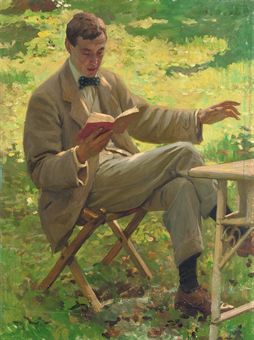
 File:AlfredMunnings by HaroldKnight.jpg

 Alfred Munnings Reading Aloud Outside on the Grass, circa 1911, by Harold Knight

I love this painting of Munnings as a young man, and wouldn’t have discovered Harold Knight if I hadn’t been looking for Munnings images.  That’ll be another Blog.

Munnings was a prolfic painter, whose works are scattered about the globe, many of them in private collections.  There is an Alfred Munnings Museum in Dedham, England, which doesn’t seem to have acquired a very large collection yet, at least insofar as I’m able to tell, but could be the first place to head for a looksee, if you happen to be in England.  He created naturalistic paintings by traveling the countryside, recording scenes like these:

Gypsies

Sotheby's London, New Bond Street - A BOY AND HIS PONY - PORTRAIT OF DAFFERN SEAL ON CANARY

Boy and Ponies

The Bush Inn

The Horse Fair

Photo Sharing and Video Hosting at Photobucket

Zenmore Hill, Cornwall

Photo Sharing and Video Hosting at Photobucket

Bagsworthy Water at Cloud

He also did many portraits and commissioned paintings, which are truly elegant and prized.

Miss Ruth Brady on Bugle Call

The Clark Sisters

Sir Raymond Greene, MP, on Horseback

The stage play and movie, War Horse, was loosely based on the story of an actual horse named Warrior owned by General Jack Seely from the Isle of Wight.  Seely wrote a memoir about his horse in 1934, which was illustrated by Alfred Munnings.

Seely on Warrior

Munnings himself served in The Great War, though not as a soldier.  He was blind in one eye and was judged unfit to fight, but served with a horse remount division on the Western Front.  He became war artist to the Canadian Cavalry Brigade and provides us with an eye-witness view of an historic tragedy, in which a generation of young men were destroyed.

Munnings captured the charm of British rural life at a time when it was in the process of vanishing.  I, personally, don’t find them sentimental.  The loveliness is real, for any who’ve seen the English counryside, and life was largely lived out of doors in a way that is healthier than it is now.

Lord Strathcona’s Horse on the March

Charge of Flowerdew’s Squadron

 Munnings captured the charm of British rural life at a time when it was vanishing.  I personally don’t find them sentimental.  The loveliness is real, for those who’ve seen the English countryside, and life was lived out of doors in a way that is healthier than it is now.  Munnings was an opponent of Modern Art.  There is an anecdote about a conversation between him and Winston Churchill in which Churchill asked him, “Alfred, if you met Picasso coming down the street would you join with me in kicking his… something something?” to which Munnings said he replied “Yes Sir, I would.”  Munnings apparently told this anecdote during his departing speech as President of the Royal Academy of Art in 1949, which was broadcastover the radio by the BBC.  He was apparently a little the worse for drink.  (I like him even better for that story.)

Monday Night Painting 4 and the Venus Effect

Odalisque

Venus with Blue Pillows

This little nude (9×12)was painted in 6 hours, the fourth of my Monday Night Paintings.  As a group, we kept commenting about how the outline of her form reminded us of the Rokeby Venus (below) by Diego Velasquez, certainly the most attractive of all the Venuses painted by the old masters, at least the one most conforming to modern tastes of beauty.  It is actually physically impossible for us to see the image that Venus is apparently looking at in that painting.  It’s called the Venus Effect, after Velasquez’ Venus and another by Veronese (although that one gives me an uncomfortable exorcist feeling).  For her head to be framed as it apparently is in the mirror, her head  would have to be between the mirror and ourselves, blocking our view.  I’ve seen this painting in person at the National Gallery in London and was completely unconscious of it being a problem.

http://www.penwith.co.uk/artofeurope/velasquez_rokeby_venus.jpg

The Rokeby Venus by Diego Velasquez

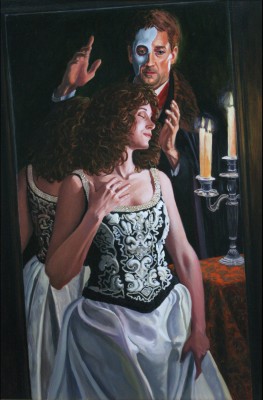
I like that — Artist’ license.  The reflected  image is also too large.  In reality it would be smaller.  I realized something like that while painting the Angel of Music.  The Phantom is meant to standing behind the mirror, in a corridor beyond Christine’s room.  At the true distance of at least 3 feet, he would appear smaller than I have portrayed him, but putting him at that distance would have wrecked the feeling of intimacy I wanted to portray.  My original intention for that painting was to have Christine facing the mirror and reaching out towards it.  However, the actual size of the reflected image in mirror, with my model standing in front of it and reaching her hand towards it, as well as the problem of angle  (the Venus Effect) caused me to paint her with her back to the mirror and very close to it.  I needed to establish that there was a reflection, but in order to see the reflection I wanted to see, Christine would have had to be transparent.

The Phantom of the Opera

The Angel of Music


Plein Air Sargent Crab

Sargent Crab in bloom

My Sargent Crab in bloom

Today, as I was headed down to the studio, to work on a small equestrian painting, I was bemoaning the fact that I wasn’t painting from life and how I really had to start plein air painting.  So, I about-faced and took my easle and palette out into the windy yard.  My yard has been gorgeous during the past several weeks, all the apple trees flowering in turn and the lilacs down by the northern fence.  I’ve sniffed the apple blossoms several times, but haven’t even been down to view the lilacs close-up.  What a crime!

Today was indeed windy.  It certainly got no warmer than 50 degrees.  I kept thrusting my hands into my pockets to warm them up between brush strokes, muttering “Levitan, Levitan, Levitan…,” channeling the artist’s hardiness, like Sandra Bullock in Miss Congeniality chanting, “Dalai Lama, Dalai Lama, Dalai Lama.”  After about two hours, I had to give it up for the day.  The wind was picking up and I’m a shoo-in for hypothermia.

This is how far I got.  It’s supposed to rain tomorrow, but it’s been supposed to rain for the past two days.  I’m hoping I can get back to it before all the petals are gone.

Monday Night Painting ( minus the painting)

I’ve just deleted a picture because I frankly didn’t like it.  It was a nude, seated figure of a woman.

However. the canvas was primed with an acrylic craft paint in a medium brown.  I often prime a canvas with a glossy Mod Podge, which prevents the oils from being absorbed into a matte ground and allows one to go for a finished product more quickly.   To the Mod Podge, one can add a few drops of acrylic paint, a light green being my favorite.  I learned these tips from Timothy C Tyler, who taught a Workshop in Rising Sun, Indiana a few years back.  (More on that in a moment.)  This canvas was primed with acrylic paint with no admixture of Mod Podge.  It was more opaque than I would have liked and was also a matte surface.

This model was quite tanned.  I found, when painting upon that opaque brown, that I was giving her skin too brown a tone.  I could see it once I had the bluish white tones of the background blocked in.  I think it was because the true tones of her skin looked too orange on that brown background and I instinctively toned them down, only to find later that I’d taken too much gold out.  I had then to try to put the warmer tones back in.  Also, her shadows were rather olive.  I can only imagine that this was due to the cool tones of the walls, but that too tipped my palate away from the warmer colors.  I would have loved to start over on this figure and use a canvas with a more familiarly colored ground.

These painting sessions are practice sessions though.  We keep learning.

The workshop I attended in Rising Sun — gosh, how many years back was that?  2006?  — was one of a number of workshops sponsored by Dick Blick called Art Now.  I’ve googled Art Now and it seems to be a defunct program.  This workshop was not only extremely fun, it was also a very productive  experience for me.  Tim is a good instructor.  He taught me how to do hair. (I painted Girl Without a Pearl Earring and The Sun on her Face in the aftermath of that workshop.)   He taught me how to paint reflections into a wet ground and how to leave the skin’s highlights for last.  I wish he was still teaching within driving range.  He offers workshops in Italy now.

We had four days, two devoted to painting a still life, two devoted to painting a portrait.   On two of the evenings, we drove into nearby Cincinnati to visit the Taft Art Museum, which is a small gem, and a gallery where Tim was having a show.   His painting of Persephone was particularly exciting to see.

A portrait of Robert Louis Stevenson by John Singer Sargent, Taft Art Museum, Cincinnati, OH

It was at the Taft that I saw my first Daubignys.  Have I mentioned that I adore Daubigny?

Monday Night Painting 2

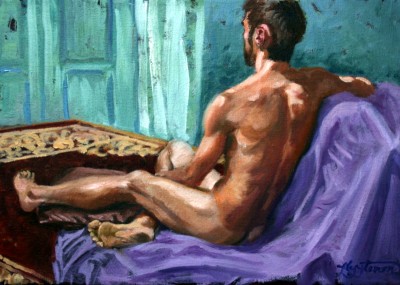
Nude male in oils

Monday Night Painting #2, 10x14

This is my second Monday Night painting.  I worked on it at the Green Lantern for 4 hours.   You can see how it looked when I brought it home below.  The carpet looked a bit like it was going to take off and give him a ride, so I repainted the corner.

Nude Male in Oils

Monday Night Painting, 10x14

Monday Night Painting

Cotton Candy Dreams
Monday Night Painting 11

Cotton Candy Dreams

On Monday nights here in Mineral Point, a group is meeting at the Green Lantern Studio for life drawing, and in my case, life painting.  We have about an half hour of 5 minute sketches, then settle down for a long pose.  I just joined the group this spring and the above is my first painting from a three-week, six-hour pose.  You can see what I brought home from the Green Lantern below.  Although I liked the negative space surrounding the figure, I didn’t like the look of shiny, white canvas — it was primed with Modge Podge to keep the oil paint sitting on the surface — so I added the toned background and scrolling, which you might recognize as the same pattern I’d created for my kitchen.

Nude Woman 1

6 Hour Painting of a Nude Woman

The American Kennel Club Museum, St Louis

Pug looking at cake painting
Willpower, Oil on Canvas by Charles Van Den Eycken 1891

One of things I wanted to do in Saint Louis was visit the American Kennel Club Museum of the Dog.  It’s located in a beautiful neighborhood across from Queeny Park.

We garmined our way there during a thunderstorm that had caught us out at Cahokia Mounds State Historic Site.   Now, I will preface this by saying I had the hours wrong in my mind.  I thought it was open until 5:00 and it turned out that it was only open until 4:00 on Saturdays.  We got there a little after 3:00.  Sue had picked up somewhere 2 for the price of 1 tickets to the Museum.  We promptly produced them and paid, only to be told by the receptionist that we had 15 minutes in which to view the collection.  I was stunned, thinking we couldn’t possibly see the artwork in only 15 minutes!

The AKC Museum was one of my priorities for my Saint Louis trip.  I’ve always liked dog and horse paintings and have painted Pugs for a couple of years.  So, when told we had only 15 minutes, I immediately began to wonder whether we shouldn’t come back the next day instead.  At that point, the docent told us that she could allow us to stay for 30 minuntes and come back tomorrow for free.  That was better.  A colleague arrived at that point from the gift shop and was immediately asked by the first lady how to do a refund.  The issue was apparently going to be decided for us.  The time period available became clearer, however.  The Museum wouldn’t be closed for another 45 minutes, as it was only 3:15, but they would begin closing at 3:45.

Mmmmm….I have to say that these two ladies didn’t seem very enthused to have visitors arrive.  As we were there, we decided to see what we could see and immediately headed for the stairwell.  The larger number of paintings were upstairs.  There were also sculptures and porcelain figurines to be seen, but since I’m a painter and didn’t know whether we’d make it back again — we had only managed to view the excellent museum at the Cahokia Visitors Center earlier and because of the rain, hadn’t been able to walk on the actual grounds, so I knew we would also be returning there, which would take considerable time — I decided to concentrate on the paintings and see as much as I could see.  The stairwell was very dark.  There were small windows letting light in from outside, but only a few of the many ceiling lights were turned on.  I called over to the desk to see if we could have any more lights turned on in the stairwell and received a very abrupt “No!  It’s only dark in there because of the rainstorm.”  (So, what were all those other lights and lightbulbs there for anyway?)

We carried on looking.  The collection is excellent and I cannot urge others strongly enough to seek out this little gem of a museum.  I can only guess that the ladies had a particular reason for making absolutely certain they got out on time that Saturday.  It was St Patrick’s Day.  Perhaps they were Irish, I don’t know.  I enjoyed the collection very much and would like to go back someday.  There is a juried art show there every year to which I would like to submit work.  If I am admitted, I would go down to St Louis again.

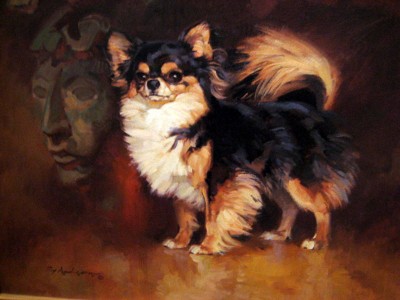
Ch. Kay’s Don Feleciano-L  by Roy Anderson 1986

There are two portraits by Roy Anderson, both lovely, at the Museum.  I liked the fact that Mayan designs were painted suggestively in the backgrounds to enhance the origin of the dog’s breeding.

Bulldog and Bloodhound Painting

Words of Comfort by J Weir


Meissen Porcelain Pugs

Porcelain Pugs by Meissen

A Meissen Pug is one of the things I most covet as objet d”art.

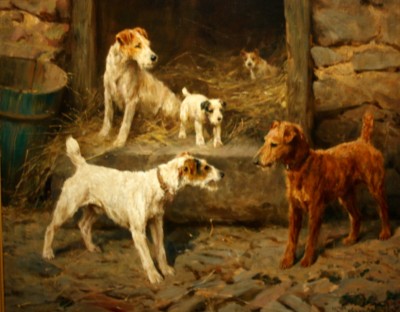
Wire-Haired Fox Terriers

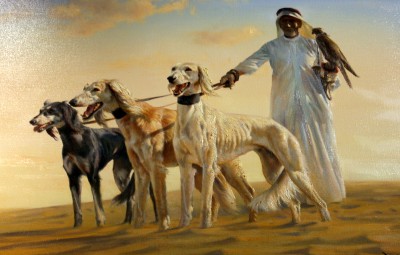
Salukis

Salukis

Horse and Dogs painting

Horse, Mastiff and Newfoundland by Arthur Batt 1881

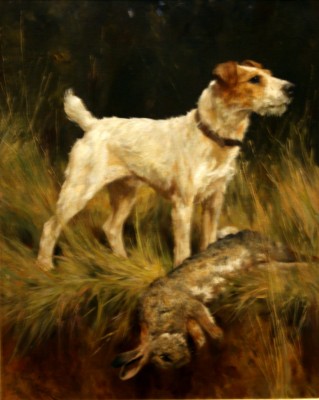
Terrier and Hare painting

Realisation by Arthur Wardle


Fox Terriers and Butterflies

Fox Terriers Chasing Butterflies by Arthur Wardle


Mastiff

Japanese Chins by Cleanthe Carr

I’m becoming familiar with some of the names of the most accomplished dog painters (besides Edwin Landseer, that is):  John Emms (English,  1864-1912), Maud Earl (English, 1864-1943), Arthur Wardle (English, 864-1949).   Note that these artists are all English.  “The influence which the Queen (Victoria) had on her subjects cannot be underestimated.  Her love of animals, her active support of animal causes and her great love of animal portraits, can only have served to instil similar interests in her subjects,” according to William Secord in Dog Painting:  A History of the Dog in Art.  I probably love dog paintings (and horse paintings as well) both because I love the animals, but because I also love things British.